

Radio Frequency Identification (RFID) and Near Field Communication (NFC) both use radio waves for wireless communication, but they serve different purposes. RFID is a broad technology category spanning multiple frequency bands and read ranges, while NFC is a specific subset of high-frequency RFID designed for short-range, two-way communication at 13.56 MHz.
In hotel key card systems, both technologies play distinct roles: RFID enables door access at various frequencies (125 kHz for legacy systems, 13.56 MHz for modern ones), while NFC allows guests to use their smartphones as room keys. Understanding the differences helps hotel operators choose the right technology for their lock systems, wristbands, and guest experience.
RFID vs NFC at a Glance
| Feature | RFID | NFC |
|---|---|---|
| Frequency | 125 kHz (LF), 13.56 MHz (HF), 860–960 MHz (UHF) | 13.56 MHz only |
| Read Range | 1 cm – 100+ meters (varies by type) | 1–10 cm maximum |
| Communication | One-way (tag → reader) | Two-way (peer-to-peer) |
| Power Source | Passive (no battery) or Active (battery-powered) | Passive (powered by reader field) |
| Multi-Tag Reading | Yes (hundreds simultaneously) | No (one device at a time) |
| Smartphone Compatible | No (requires dedicated reader) | Yes (built into modern phones) |
| Cost per Tag | $0.05–$25 (passive to active) | $0.10–$2.00 |
| Data Transfer Speed | Up to 640 Kbps (UHF) | Up to 424 Kbps |
| Security | Varies (none to AES-128) | AES-128 encryption standard |
| Hotel Use | Key cards, wristbands, asset tracking | Mobile key, contactless payments, smart posters |
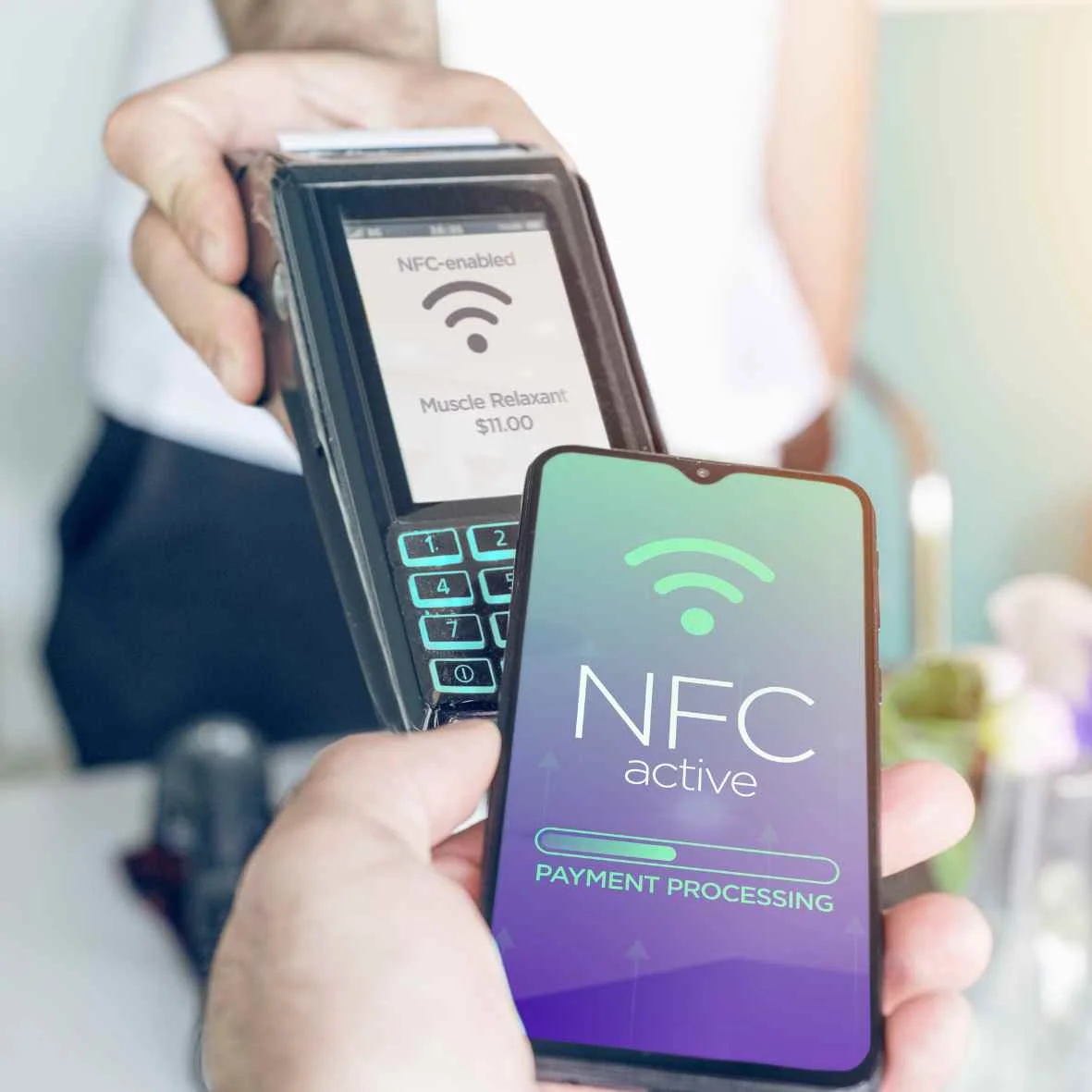
RFID vs NFC: understanding the technology behind modern contactless hotel key cards
RFID vs NFC in 16 Questions and Answers
1. Can a smartphone with NFC read all types of RFID tags?
No. NFC devices only read tags operating at 13.56 MHz (the high-frequency RFID band). RFID technology spans three frequency ranges — low frequency (125/134.2 kHz), high frequency (13.56 MHz), and ultra-high frequency (860–960 MHz). An NFC smartphone can read HF RFID and NFC tags, but cannot read LF or UHF RFID tags.
2. Which is better for hotels — RFID or NFC?
Both serve different purposes. RFID cards (particularly MIFARE at 13.56 MHz) are the standard for physical hotel key cards because they're durable, inexpensive, and compatible with all major lock systems. NFC is better for mobile key solutions — guests use their smartphone instead of a physical card. Most modern hotels deploy both: RFID cards at check-in and NFC mobile key as an option via the hotel app.
3. Is an RFID tag the same as an NFC tag?
Not exactly. Both use radio frequency for wireless communication, but NFC tags support two-way communication (send and receive), while RFID tags are typically one-way (tag responds to reader). NFC tags operate only at 13.56 MHz with a range of a few centimeters, while RFID tags span multiple frequencies and can be read from much farther away.
4. Is NFC more expensive than RFID?
It depends on the RFID type. Passive LF/UHF RFID tags ($0.05–$0.15) are cheaper than NFC tags ($0.10–$2.00) due to simpler designs. However, at the HF 13.56 MHz frequency where both technologies overlap, pricing is comparable. For hotel key cards specifically, MIFARE Ultralight C (RFID) costs $0.20–$0.50 per card, similar to NFC-enabled alternatives.
5. Can NFC utilize the same technology as RFID?
Yes — NFC is technically a subset of HF RFID. Both operate at 13.56 MHz and share the same underlying radio frequency principles. NFC can be integrated into existing HF RFID infrastructure without modification. The key difference is that NFC adds two-way communication and secure data exchange capabilities on top of the base RFID functionality.
6. Is it possible to use an NFC tag as an RFID tag?
Yes, provided the RFID reader operates at 13.56 MHz (HF band). An HF RFID reader can read the data stored on an NFC tag, though it won't be able to use NFC-specific features like peer-to-peer communication. In hotel environments, this means NFC wristbands can work with existing HF RFID door locks.
7. Can NFC read signals at 13.56 MHz?
Yes. NFC is specifically designed to operate at 13.56 MHz. NFC devices can read both NFC tags and any HF RFID tag operating at this frequency, including MIFARE Classic, MIFARE DESFire, and ISO 15693 tags.
8. What wavelength do NFC signals have?
NFC signals have a wavelength of approximately 22 meters (calculated from the speed of light ÷ 13.56 MHz). Despite this relatively long wavelength, NFC's effective communication range is limited to a few centimeters because NFC devices use near-field magnetic coupling rather than far-field radio wave propagation.
9. Is NFC a low-frequency technology?
No. NFC operates at 13.56 MHz, which falls in the high-frequency (HF) band. Low-frequency RFID operates at 125 kHz or 134.2 kHz — roughly 100 times lower than NFC. The higher frequency of NFC enables faster data transfer rates and smaller antenna sizes, which is why NFC can be built into thin smartphones.
10. NFC or RFID — which should you choose?
Choose RFID when you need long-range reading (warehouse inventory, asset tracking), simultaneous multi-tag reading, or when devices don't have NFC capability. Choose NFC when you need short-range secure communication (contactless payments, mobile key), two-way data exchange, or smartphone compatibility. For hotel key cards, use RFID cards (MIFARE) for physical access and NFC for mobile key integration.
11. Can NFC and RFID be used interchangeably?
Only at 13.56 MHz. NFC is a subset of HF RFID, so NFC devices can read HF RFID tags and vice versa. However, NFC cannot replace LF RFID (125 kHz) or UHF RFID (860–960 MHz) systems. In practice, an NFC smartphone can open a hotel door equipped with a 13.56 MHz MIFARE lock, but cannot interact with a legacy 125 kHz system.
12. Do smartphones use RFID or NFC?
Modern smartphones use NFC. Apple iPhones (iPhone 7 and later) and most Android devices include NFC chips for Apple Pay, Google Pay, and contactless interactions. Smartphones do not include RFID readers — they cannot read LF (125 kHz) or UHF (860–960 MHz) tags. Some third-party accessories add RFID reading capability via Bluetooth.
13. Why is RFID preferred over NFC in some applications?
RFID excels where NFC cannot: reading hundreds of tags simultaneously from meters away. A warehouse RFID system can inventory an entire room in seconds. RFID also works in harsh environments (extreme temperatures, moisture, dust) where smartphone-based NFC would be impractical. For hotel supply chain management and linen tracking, UHF RFID is the standard choice.
14. What distinguishes RFID, NFC, and BLE?
RFID uses dedicated radio frequencies (125 kHz – 960 MHz) for tag identification. NFC operates at 13.56 MHz for secure short-range communication. Bluetooth Low Energy (BLE) uses the 2.4 GHz ISM band for medium-range (up to 100m) low-power communication. In hotels, all three coexist: RFID key cards for doors, NFC for mobile key, and BLE for indoor positioning and smart room controls.
15. How do NFC implants differ from RFID implants?
NFC implants are used for personal identification — unlocking phones, doors, or sharing contact information — leveraging NFC's short range for security (the reader must be within centimeters). RFID implants are used in animal identification and livestock tracking, utilizing longer read ranges. Both types are biocompatible glass capsules, typically 2mm × 12mm, injected subdermally.
16. Can an NFC reader read an RFID tag?
Only if the RFID tag operates at 13.56 MHz (HF band). NFC readers are designed for this frequency and can read any compatible HF RFID tag, including MIFARE Classic, MIFARE DESFire, ISO 14443, and ISO 15693 tags. NFC readers cannot read low-frequency (125 kHz) or ultra-high-frequency (860–960 MHz) RFID tags.