
Last updated: February 2026
The hospitality industry talks about mobile key vs key card as though the transition is already happening. It is not — at least not at the pace the headlines suggest. According to a CNBC report from September 2024, 94% of hotel guests say they want mobile check-in, but only 14% of guests at branded hotels actually use a digital key when one is available. Even among guests who have downloaded the hotel app, 70% still choose to pick up a physical card at the front desk.
That 80-point gap between desire and behavior is the real story. This article explains why it exists, breaks down the two fundamentally different mobile key technologies that most comparison articles conflate, lists which hotels actually support Apple Wallet and Google Wallet keys today, and provides the hard cost data that hotel decision-makers need. We write this as a card manufacturer that sees both sides honestly: mobile keys are the future direction, but physical RFID key cards remain the present reality for the vast majority of the world's hotels.
The 94% vs 14% Problem: Why Mobile Keys Haven't Replaced Key Cards
The gap between stated preference and actual usage is not a mystery once you examine what "using a mobile key" actually requires. The 14% adoption figure from CNBC reflects real-world behavior across major branded hotels where mobile key is available and actively promoted. Several friction points explain the difference.
App download fatigue. Most hotel mobile key systems (Hilton Digital Key, Marriott Mobile Key) require downloading the brand's app, creating an account, enabling Bluetooth, granting location permissions, and enabling background app refresh. That is five permission gates before the key works. Guests booking a single night at a Hilton Express are unlikely to go through that process for one stay.
Inconsistent property support. Hilton advertises Digital Key at 5,400+ properties, but not every room at every property has a BLE-enabled lock. A guest who downloads the app and sets up the key may discover at check-in that their specific building or floor does not support it. That single bad experience kills adoption for future stays.
BLE reliability issues. Bluetooth Low Energy keys have a documented 5 to 10 second response time — the guest holds the phone near the lock, waits for the Bluetooth handshake, and then the door unlocks. Compare that to the instant tap of an RFID card. Guests who experience the delay once often revert to the physical card.
Demographics and travel context. Business travelers, families with children, group conference attendees, and guests over 55 disproportionately prefer physical cards. Secondary guests (spouse, children) need their own key, and most mobile key systems do not support easy sharing.
Backup cards remain mandatory. Every hotel offering mobile key still issues physical cards as backup. The front desk and the card infrastructure remain fully operational regardless of mobile key adoption. This is not a transition — it is an addition.
How Hotel Mobile Keys Work: NFC Wallet Keys vs BLE App Keys
This is the critical distinction that most hotel technology articles miss entirely. There are two fundamentally different mobile key technologies deployed in hotels today, and they differ in every way that matters to guests: setup friction, reliability, battery dependency, and security architecture.
NFC Wallet Keys (Apple Wallet / Google Wallet)
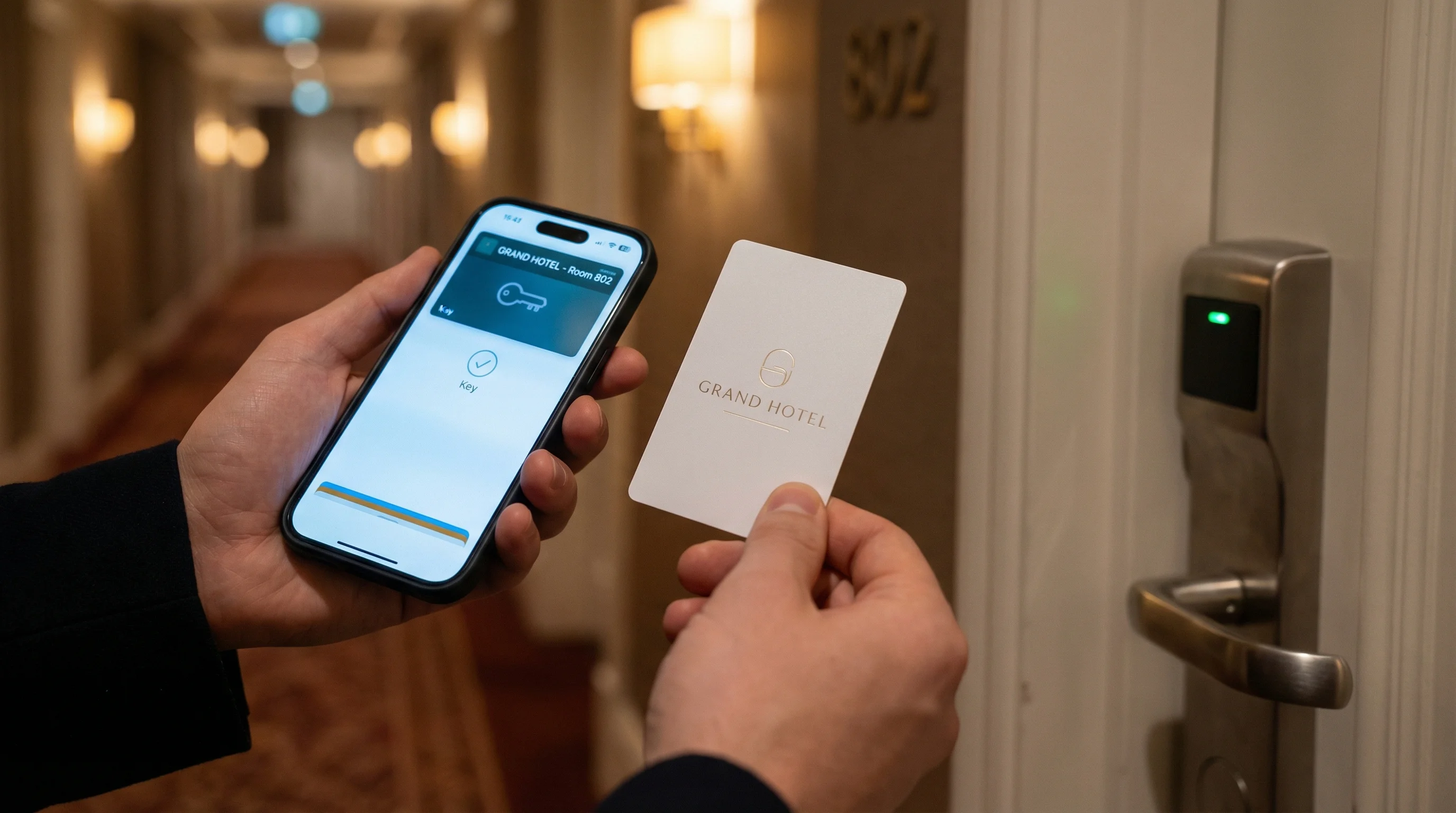
NFC wallet keys store the room credential directly in the phone's Secure Element — the same hardware-backed encryption chip that protects Apple Pay and Google Pay transactions. No app download is required. The key appears as a pass in Apple Wallet or Google Wallet, and the guest taps the phone against the NFC reader on the door lock exactly like tapping to pay at a store. Response is instant.
On Apple devices, Express Mode is enabled by default, meaning the guest does not need to unlock the phone or authenticate with Face ID. Just hold the iPhone or Apple Watch near the lock. Apple's Power Reserve feature keeps the NFC credential accessible for up to 5 hours after the phone battery dies (iPhone XS/XR and later). This is a significant reliability advantage over BLE keys.
BLE App Keys (Hilton Digital Key, Marriott Mobile Key)
BLE (Bluetooth Low Energy) app keys require the guest to download the hotel chain's native app, create an account, check in via the app, and enable Bluetooth plus background app refresh. The phone communicates with the lock via Bluetooth, not NFC. Response time averages 5 to 10 seconds as the phone and lock complete the BLE handshake. The phone must have an active battery and the app must be running in the background.
If the phone battery dies, a BLE key is completely inaccessible — there is no equivalent to Apple's Power Reserve for Bluetooth. If the app crashes or the operating system kills the background process (common on Android), the key may fail even with battery remaining.
| Feature | NFC Wallet Key | BLE App Key | Physical RFID Card |
|---|---|---|---|
| App download required | No | Yes | No |
| Response time | Instant tap (<1 second) | 5-10 seconds | Instant tap (<1 second) |
| Phone unlock needed | No (Express Mode) | Varies by app | N/A |
| Works with dead battery | Yes — 5 hours (Apple only) | No | No battery needed |
| Bluetooth required | No | Yes | No |
| Encryption | Hardware-backed AES (Secure Element) | Software-based TLS | AES-128 (advanced) or legacy encryption (basic) |
| Lock hardware required | NFC-enabled lock | BLE-enabled lock | RFID reader (standard) |
| Supported phones | iPhone XS+ / Android 9.0+ with NFC | Most smartphones with BLE | N/A |
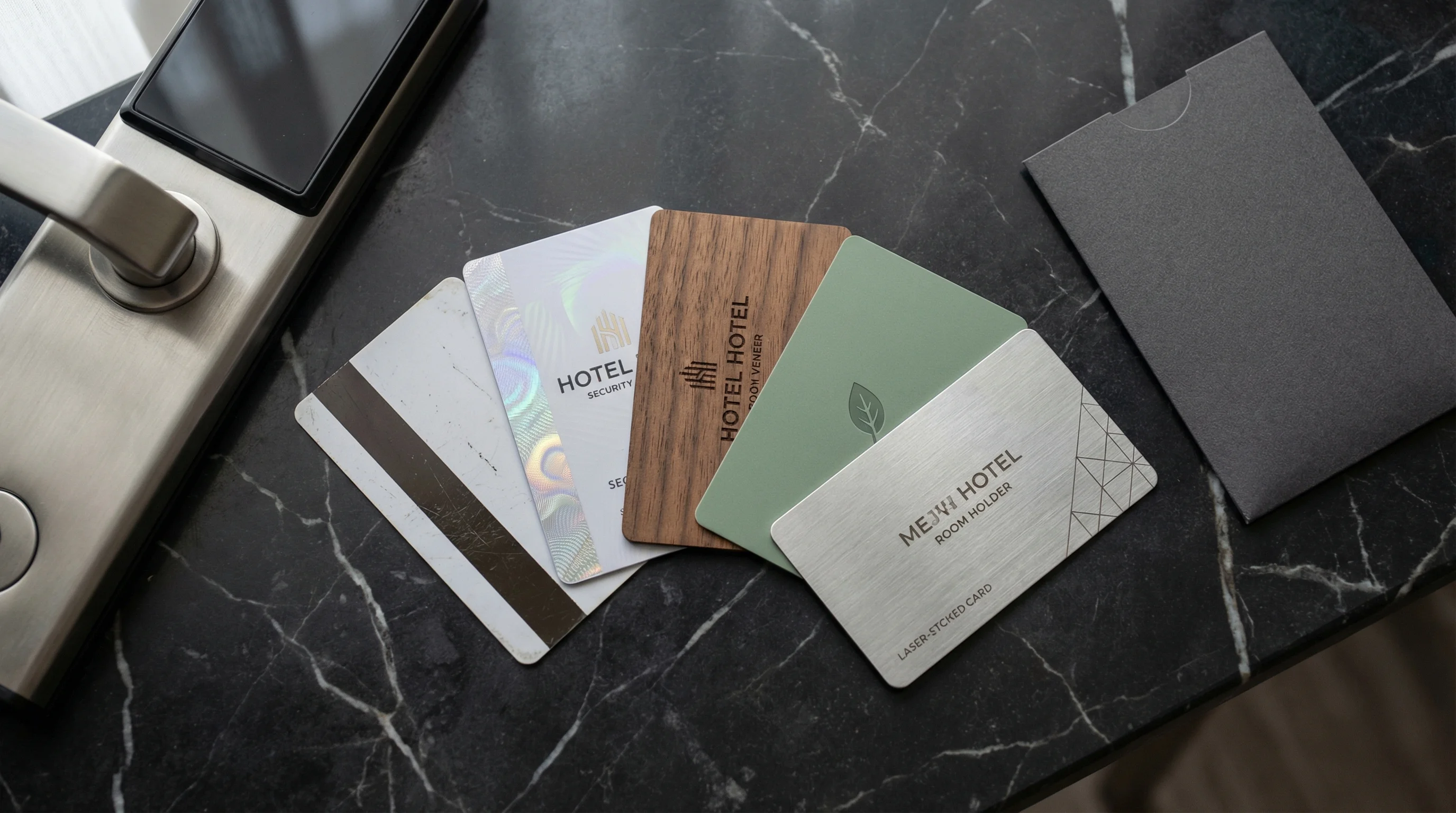
Physical key card types still in production: magstripe, holographic RFID, wooden veneer, bio-PVC, and laser-etched metal -- all coexisting with mobile key
Which Hotels Support Apple Wallet and Google Wallet Keys
This is the information travelers search for most and find least reliable answers to. Below is a verified list of hotel chains and their mobile key technology status as of early 2026. The distinction between BLE app keys (most common) and NFC wallet keys (newer, less deployed) matters — they are not interchangeable.
| Hotel Chain | Mobile Key Properties | Technology | Apple Wallet | Google Wallet |
|---|---|---|---|---|
| Hilton | 5,400+ | BLE app (Digital Key) | Select properties only | No |
| Hyatt | 600+ | NFC + BLE | Yes (flagship, Dec 2021 first) | Select properties |
| Marriott | 500+ | BLE app (Mobile Key) | No | No |
| IHG | 250+ (targeting 1,500 by end 2026) | BLE app | Pilot stage | No |
| Accor | 500+ (50% of network targeted in 5 years) | BLE app | No | No |
| Club Quarters | All locations | NFC wallet | Yes (all properties, Jan 2025) | Yes (all properties, Jan 2025) |
| Clarion Hotel Post (Sweden) | 1 property | NFC wallet | Yes | Yes (first Google Wallet hotel key, Jun 2024) |
| Resorts World Las Vegas | 1 property | NFC wallet (via Alliants) | Yes (no app needed, Jun 2025) | No |
| Independents (via FLEXIPASS / Alliants) | Varies | NFC wallet | Yes (via middleware) | Yes (via middleware) |
A few key observations. Hilton leads in total BLE app key deployment with 135 million door openings and 12.3 million keys downloaded, but it has not broadly adopted NFC wallet keys. Hyatt was the first hotel brand to offer an Apple Wallet key in December 2021. Club Quarters became the first chain to deploy both Apple Wallet and Google Wallet keys at all locations in January 2025. And Resorts World Las Vegas, using Alliants middleware (a TIME Best Inventions 2025 honoree), became the first property to offer a no-app-needed Apple Wallet key in June 2025.
Major lock manufacturers have released NFC-enabled hardware supporting wallet key deployments. Middleware providers FLEXIPASS and Alliants (via Canary Technologies) bridge the gap between existing PMS systems and wallet key protocols.
Apple Wallet Hotel Key: How It Works Step by Step
The Apple Wallet hotel key is the most seamless mobile key experience available in 2026. Here is the exact guest flow at a supporting property:
Step 1: Book a room at a participating hotel (Hyatt, Club Quarters, or an independent using Alliants/FLEXIPASS middleware).
Step 2: Receive a notification or email with a link to add your room key to Apple Wallet. Some properties push the key automatically after online check-in.
Step 3: Tap "Add to Apple Wallet." The credential is provisioned to your iPhone's Secure Element — the same tamper-resistant chip that stores Apple Pay cards.
Step 4: Express Mode is enabled by default. No Face ID, Touch ID, or passcode is needed to use the key.
Step 5: At the hotel, hold the top of your iPhone or Apple Watch near the door lock's NFC reader. The door unlocks instantly — identical to tapping Apple Pay at a terminal.
Step 6: If you extend your stay or change rooms, the credential updates remotely. No need to visit the front desk.
Step 7: At checkout, the key is automatically deactivated, or you can manually remove it from Wallet.
Power Reserve: If your iPhone battery dies, the NFC credential remains accessible for up to 5 hours via Power Reserve (iPhone XS, XR, and all later models). This is the single most important advantage over BLE app keys — you are not locked out of your room because your phone ran out of battery at dinner.
Apple Watch support means you can leave your phone charging in the room and still access your door, the elevator, and common areas from your wrist.
Google Wallet Hotel Key: How It Works
Google Wallet hotel keys follow a similar flow but with key differences. The credential is stored in the phone's NFC controller, and the guest taps the phone against the lock reader. Setup requires Android 9.0 or later with NFC hardware.
The first Google Wallet hotel key deployment was at Clarion Hotel Post in Gothenburg, Sweden, in June 2024. Club Quarters added Google Wallet alongside Apple Wallet at all locations in January 2025.
The critical difference: Google Wallet has no Power Reserve equivalent. When an Android phone's battery dies, the NFC credential is completely inaccessible. A dead phone means a locked door and a walk to the front desk. This is a meaningful reliability gap compared to Apple's 5-hour Power Reserve window.
Google Wallet keys also require the phone to be unlocked before tapping — there is no Express Mode equivalent where the phone works from a locked state. This adds a small but noticeable friction step at every door.
Mobile Key vs Key Card: Full Comparison Table
This is the comprehensive side-by-side that hotel technology teams and curious travelers need. Every factor that affects daily use, operational cost, and guest satisfaction is included.
| Factor | Physical RFID Card | Mobile Key (NFC Wallet) | Mobile Key (BLE App) |
|---|---|---|---|
| Reliability | Very high (no battery, no software) | High (Secure Element, Power Reserve) | Moderate (BLE handshake, app crashes) |
| Security | Chip-dependent (AES-128 on advanced encrypted cards) | Hardware-backed AES (Secure Element) | Software-based TLS encryption |
| Cost to hotel (per door) | $0 (existing infrastructure) | $200-$800 (NFC lock upgrade) | $200-$800 (BLE lock upgrade) |
| Monthly SaaS cost | $0 | $2-$10 per room/month | $2-$10 per room/month |
| Guest setup friction | None (handed card at desk) | Low (add to Wallet, 1 tap) | High (download app, create account, enable BLE) |
| Works without battery | Yes (passive RFID) | 5 hours after dead (Apple only) | No |
| Works without internet | Yes | Yes (after initial provisioning) | Yes (after initial provisioning) |
| Shareable with travel companion | Yes (issue duplicate at desk) | Limited (Apple sharing in development) | Limited (some apps support sharing) |
| Universal compatibility | Yes (if chip matches lock) | No (requires NFC lock + iPhone XS+/Android 9+) | No (requires BLE lock + app) |
| Demagnetization risk | None (RFID) / High (magstripe) | None | None |
| Environmental impact | PVC waste (mitigated by recycled/wood cards) | No physical waste | No physical waste |
| Guest satisfaction | Universally accepted | Very high (among users) | Mixed (BLE delays frustrate some guests) |
| Backup card required | N/A (is the backup) | Yes (card still issued) | Yes (card still issued) |
Hotel Mobile Key Not Working: Troubleshooting Guide
If your hotel mobile key is not working, the fix depends on whether you are using a BLE app key or an NFC wallet key. The failure modes are different for each technology.
BLE App Key Troubleshooting (Hilton Digital Key, Marriott Mobile Key)
- Check that Bluetooth is on. BLE keys require active Bluetooth. If you toggled it off for battery savings, the key will not work.
- Verify app permissions. The app needs Bluetooth, Location Services, and Background App Refresh enabled. On iOS, go to Settings > [Hotel App] and confirm all three.
- Force-close and reopen the app. A crashed background process is one of the most common BLE key failures. Close the app completely and relaunch it.
- Check battery level. BLE requires active battery. If your phone is in Low Power Mode, some BLE functions may be restricted.
- Re-login to the app. Session tokens expire. Logging out and back in refreshes the credential.
- Wait 10 seconds at the door. BLE handshakes take 5-10 seconds. Guests accustomed to RFID tap speed often walk away before the lock has finished processing.
NFC Wallet Key Troubleshooting (Apple Wallet, Google Wallet)
- Check Express Mode (Apple). Go to Settings > Wallet & Apple Pay > [Hotel Key] and verify Express Mode is enabled.
- Hold the phone flat against the reader for 2 seconds. NFC range is short (typically 4 cm). Hold the top of the iPhone directly against the lock reader — do not wave or tap quickly.
- Verify the key is active in Wallet. Open Apple Wallet or Google Wallet and confirm the hotel key pass is present and shows an active status.
- Restart the phone. An NFC controller glitch can prevent credential transmission. A restart clears it.
Both Types: General Checks
- Verify checkout time has not passed. Mobile keys expire at checkout time, just like physical cards. If you extended your stay but the PMS did not update the credential, the key will stop working.
- Try a different door. If the key works at the elevator or fitness center but not your room, the room lock may have a hardware issue (dead battery, firmware glitch).
- Visit the front desk. The front desk can re-provision the mobile key or issue a physical RFID card as backup. This is why physical cards remain essential infrastructure — they are the universal fallback when any digital system fails.
The Real Cost: Mobile Key Infrastructure vs Key Cards
Hotel decision-makers evaluating mobile key need accurate cost data, not vendor marketing. Here is what the investment actually looks like for a 200-room hotel.
Mobile Key Infrastructure Cost
| Cost Component | Low Estimate | High Estimate |
|---|---|---|
| Lock upgrade (200 doors x $200-$800) | $40,000 | $160,000 |
| Installation labor ($30-$150/door) | $6,000 | $30,000 |
| Monthly SaaS ($2-$10/room x 200 rooms x 12 months) | $4,800/year | $24,000/year |
| PMS integration and middleware | $5,000 | $25,000 |
| Year 1 Total | $55,800 | $239,000 |
| Annual recurring (Year 2+) | $4,800 | $24,000 |
Annual Physical Key Card Cost (200-Room Hotel)
For comparison, here is what the same 200-room hotel spends on physical RFID key cards annually, assuming 70% occupancy, 2 cards per room per stay, and a 50% card return rate:
| Cost Component | Annual Cost |
|---|---|
| Cards issued per year (~102,200) | — |
| Cards lost at 50% return (~51,100 replacements) | — |
| Card cost at $0.30/unit | ~$15,330 |
| Encoders (already owned) | $0 |
| Annual Total | ~$15,330 |
When Does Mobile Key Pay for Itself?
At 14% mobile key adoption, a 200-room hotel reduces its annual card spend by approximately $2,150 (14% of $15,330). Against a minimum first-year mobile key investment of $55,800, that yields an ROI timeline of over 25 years on card savings alone. Even at an aggressive 30% adoption rate, card savings reach roughly $4,600 per year — still a 12+ year payback on the infrastructure investment.
Mobile key ROI therefore depends on indirect benefits: reduced front desk labor, faster check-in, guest satisfaction scores, and competitive positioning. The card savings alone do not justify the investment. And here is the catch that vendors rarely emphasize: you still need physical cards even with mobile key deployed at 100% of rooms, because 70-86% of guests will continue using them.
For a detailed breakdown of card economics, see our hotel key card cost guide.
Why Physical Hotel Key Cards Aren't Going Away
We are a card manufacturer, so we have an obvious interest in this conclusion. But the data supports it independently. At 14% digital key adoption across branded hotels — after over a decade of investment by Hilton, Marriott, Hyatt, and others — physical RFID key cards remain the primary access method for 86% of hotel guests.
The backup requirement is universal. Every hotel offering mobile key still issues physical cards. Apple, Google, Hilton, and every lock vendor recommend physical backup. A hotel cannot operate without card inventory regardless of mobile key adoption.
Group check-ins and conferences. A 500-person conference needs 500 room keys in 90 minutes. That is a front desk operation optimized over decades for physical cards. Mobile key provisioning at that scale and speed is not yet reliable.
Children and secondary guests. A family of four checking into two rooms needs 4-6 keys. Children without smartphones need physical cards. Most mobile key systems do not support easy multi-guest credential sharing.
Walk-in guests. No app, no pre-check-in, no reservation linked to a loyalty account. Walk-ins get a physical card.
Budget and mid-range hotels. The $200-$800 per-door lock upgrade cost is prohibitive for a 150-room budget hotel generating $60-$80 per night. The monthly SaaS fee adds a recurring cost with no clear payback at typical adoption rates. The global hotel market is overwhelmingly mid-range and budget — not the luxury segment where mobile key is concentrated.
Independent hotels and non-US/EU markets. Mobile key infrastructure requires compatible PMS systems, reliable internet, and lock vendor partnerships that many independent hotels and properties in developing markets do not have.
Cards are evolving, not disappearing. The key card industry is responding to sustainability pressure with recycled PVC, bio-PVC, and FSC-certified wooden key cards. These address the environmental argument against physical cards while maintaining universal compatibility. For more on this trend, see our guide on which hotel chains are switching to wooden key cards.
Card Volume Projection: 200-Room Hotel
Here is what mobile key adoption actually means for card volume at a typical 200-room hotel running at 70% occupancy:
Mobile key reduces card consumption by 14-30% at current and optimistic adoption rates. It does not eliminate it. Hotels still need the infrastructure, the inventory, and the front desk workflow to produce tens of thousands of physical keys per year. The hybrid model — mobile key as an option, physical card as the default — is the industry standard for the foreseeable future.
Frequently Asked Questions
Does Apple Wallet hotel key work when phone is dead?
Yes, on iPhone XS, XR, and all later models. Apple's Power Reserve feature keeps the NFC credential accessible for up to 5 hours after the battery dies. You can still tap your iPhone to unlock your hotel room door during this window. This feature uses the Secure Element's independent power, separate from the main battery. Apple Watch hotel keys have the same Power Reserve capability. Google Wallet on Android does not have an equivalent feature — a dead Android phone means no access.
Which hotel chains support mobile key in 2026?
Hilton (5,400+ properties via BLE app), Hyatt (600+ via NFC and BLE), Marriott (500+ via BLE app), IHG (targeting 1,500 properties), and Accor (500+ with plans for 50% of network in 5 years). For NFC wallet keys specifically, Hyatt, Club Quarters (all locations), and independents using FLEXIPASS or Alliants middleware support Apple Wallet. Google Wallet hotel keys are available at Club Quarters and Clarion Hotel Post, with more deployments expected through 2026.
Is a mobile hotel key more secure than a physical card?
NFC wallet keys (Apple Wallet, Google Wallet) use the phone's Secure Element with hardware-backed AES encryption — the same security architecture as Apple Pay. This is at least as secure as an AES-128 encrypted RFID card and more secure than legacy RFID cards. BLE app keys use software-based TLS encryption, which is adequate but does not have the hardware-level tamper resistance of Secure Element keys. Physical RFID card security depends entirely on the chip: advanced encrypted cards with AES-128 have no known attacks, while legacy RFID cards with outdated encryption have been broken since 2008.
How much does it cost a hotel to add mobile key?
Lock upgrades cost $200-$800 per door for BLE or NFC-enabled hardware. Installation runs $30-$150 per door. Monthly SaaS fees range from $2-$10 per room per month. For a 200-room hotel, first-year costs range from $55,800 to $239,000. Annual recurring costs (SaaS only) run $4,800-$24,000. The hotel also retains its full physical key card infrastructure because 70-86% of guests continue using cards.
Can I share my mobile hotel key with someone?
Sharing depends on the platform. Apple is developing key sharing through iMessage for Apple Wallet hotel keys, but support is limited to select properties. Most BLE app keys (Hilton, Marriott) allow sharing within the app's loyalty account ecosystem, but the recipient must also have the app installed and an account created. Physical key cards remain the simplest sharing method — the front desk issues a duplicate card in seconds with no technology requirements.
Why does my hotel mobile key keep failing?
For BLE app keys, the most common causes are Bluetooth being toggled off, the app being killed by the operating system's background process manager, expired session tokens requiring re-login, and low battery restricting BLE function. For NFC wallet keys, failures are rarer but can result from the phone not being held close enough to the lock reader (NFC range is approximately 4 cm), Express Mode being disabled, or the credential not being properly provisioned. In all cases, the front desk can issue a physical backup card immediately.
Will hotels stop making physical key cards?
No. At 14% digital key adoption after a decade of major-chain investment, physical key cards remain essential for 86% of hotel guests. Every hotel offering mobile key still issues physical cards as backup. Group check-ins, children, walk-ins, budget properties, and markets without mobile key infrastructure all require physical cards. Card volumes may decrease 14-30% at mobile-key-enabled properties, but elimination is not on any realistic timeline. The industry is moving toward sustainable card materials rather than card elimination.
What is the difference between NFC and BLE hotel keys?
NFC (Near Field Communication) hotel keys store the credential in the phone's Secure Element and communicate via radio frequency at very short range (4 cm), with instant response time. They require no app download and work via Apple Wallet or Google Wallet. BLE (Bluetooth Low Energy) hotel keys require a dedicated hotel app, use Bluetooth to communicate with the lock from up to 10 meters, and have a 5-10 second response time. NFC keys work up to 5 hours after battery death (Apple only). BLE keys require active battery. NFC wallet keys are newer and less widely deployed; BLE app keys are the current majority of mobile key installations. For more on how different key card technologies work and fail, see our troubleshooting guide.
About PrintPlast
PrintPlast is a manufacturer of RFID hotel key cards, wooden key cards, and access control products serving hotels in over 80 countries. We supply key cards compatible with all major lock systems in chip types from encrypted RFID through AES-128 encrypted contactless chips. We see mobile key as a complement to physical cards, not a replacement — and we build our product line to serve the hybrid model that the industry has adopted.
Need Key Cards That Coexist With Mobile Key?
Whether your property runs mobile key alongside physical cards or relies entirely on RFID, PrintPlast supplies key cards matched to your lock system. Available in standard PVC, recycled PVC, bio-PVC, and FSC-certified wood — all compatible with NFC and BLE-enabled lock systems.