
Last updated: April 2026
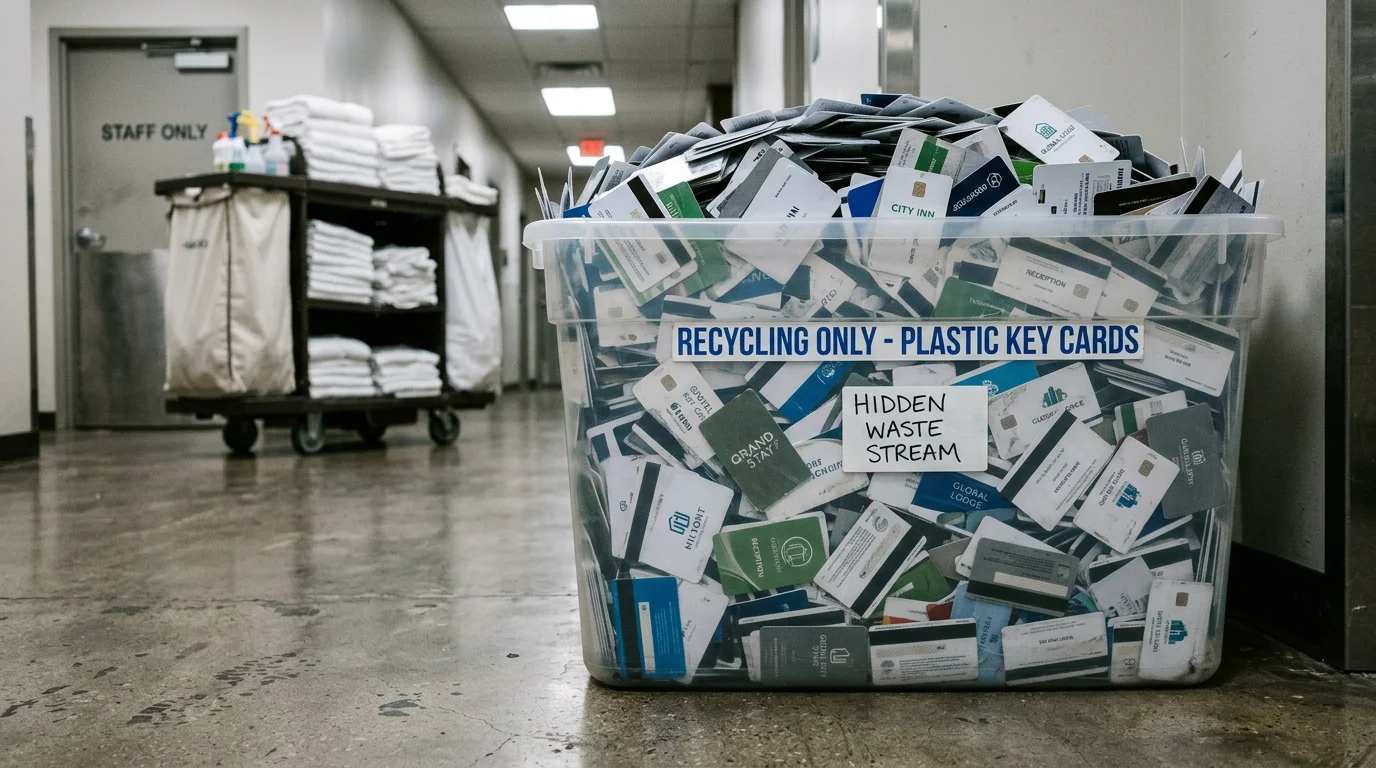
The global hotel industry produces an estimated 6 billion plastic key cards every year. Most are standard PVC -- polyvinyl chloride -- a material that takes 300 to 500 years to decompose in landfill and releases hydrogen chloride gas when incinerated. Unlike PET bottles or aluminum cans, PVC hotel key cards have no established consumer recycling pathway in any country. Municipal recycling facilities cannot process them, guests do not know what to do with them, and hotels rarely collect them. This article examines the full lifecycle of a hotel key card, the real barriers to hotel key card recycling, and the sustainable material alternatives that are replacing virgin PVC worldwide.
The Scale of the Problem: 6 Billion Cards, Under 1% Recycled
The global hotel industry operates approximately 17.5 million rooms across 700,000 properties (STR Global, 2025). The average room turns over 200 to 300 times per year, consuming 1.5 to 2 key cards per turnover. That arithmetic produces roughly 6 billion key cards annually -- a figure confirmed by AHLA and manufacturing volume data. The overwhelming majority are virgin PVC, which dominates production because it costs $0.08 to $0.25 per card, survives pocket abuse, and accepts high-resolution printing without delamination. The problem is what happens after use.
Why Municipal Recycling Cannot Handle Key Cards
PVC is classified as Resin Identification Code #3. Most municipal programs accept only #1 (PET) and #2 (HDPE). A single PVC card mixed into a PET batch can ruin the entire melt -- PVC degrades at a lower temperature and releases chlorine gas during reprocessing. Hotel key cards compound the problem further: each contains an RFID inlay (copper antenna bonded to a silicon chip) laminated between PVC layers, making it a composite material that requires specialized separation equipment no municipal facility possesses.
What Hotels Currently Do with Used Cards
The honest answer: almost nothing. Large branded hotels reuse cards for 3 to 6 stays before discarding worn stock. Independent hotels often issue cards for a single stay. In both cases, discarded cards go into general waste -- landfill or incineration. A small number of hotels have tried collection bins at checkout, but recovery rates rarely exceed 15 to 20%. Guests forget cards in rooms, take them as souvenirs, or pocket them and throw them away at home.
The Full Lifecycle of a Hotel Key Card
Following a standard PVC hotel key card from production to disposal reveals why the environmental impact is worse than the raw material alone suggests.
Stage 1: Raw Material Extraction
PVC is manufactured from ethylene (derived from crude oil or natural gas) and chlorine (produced via electrolysis of salt brine). The chlor-alkali process is extremely energy-intensive -- approximately 2,500 kWh per ton of chlorine. PVC resin production emits vinyl chloride monomer (VCM), a Group 1 carcinogen classified by IARC.
Stage 2: Card Manufacturing
PVC sheets are printed, laminated with an RFID inlay sandwiched between layers, and die-cut to CR80 standard size. Manufacturing waste (trim edges, misprints, test cards) accounts for 8 to 12% of material input and is typically recycled back into the production line. End-of-life cards from hotels, however, almost never make it back to the manufacturer.
Stage 3: Distribution and Use
Cards ship from manufacturer to hotel in boxes of 200 or 500. The carbon footprint varies enormously by origin: Turkey to Amsterdam is 2,800 km; China to Amsterdam is 19,000 km. A 200-room hotel uses approximately 8,000 to 15,000 key cards per year.
Stage 4: End of Life
Without a return pathway, used cards follow one of three routes:
- Landfill (approximately 80%): PVC fragments into microplastics over centuries. Plasticizers leach into soil and groundwater. The embedded RFID chip adds trace heavy metals to the waste stream.
- Incineration (approximately 19%): Burning PVC releases hydrogen chloride gas, dioxins, and furans -- persistent organic pollutants under the Stockholm Convention.
- Recycling or reuse (approximately 1%): A tiny fraction is collected through manufacturer take-back programs. Most programs downcycle PVC into lower-grade products rather than producing new cards.
Closed-Loop Recycling: Does It Actually Work?
A closed-loop hotel key card recycling program collects used cards, separates the RFID inlay from the PVC body, grinds the PVC into pellets, and uses those pellets to manufacture new cards. In theory, this is ideal. In practice, only a handful of programs exist and they face significant headwinds.
The Economics and Logistics Problem
Virgin PVC resin costs $1,000 to $1,200 per ton. Collecting, transporting, sorting, and regrinding used cards costs $1,800 to $2,500 per ton -- and the recovered PVC is degraded. The logistics are equally challenging: a hotel chain with 500 properties across 40 countries would need collection bins, staff training, and a consolidation network. A 200-room hotel discards only 25 to 40 kg of cards per year, but the minimum efficient recycling batch is approximately 500 kg. You need 15 to 20 hotels feeding into a single collection point before a single batch can run.
Several manufacturers operate regional take-back programs with recovery rates of 30 to 50% within participating hotels. But the honest assessment: closed-loop recycling cannot solve the scale of collecting 6 billion cards from 700,000 properties. The better answer is eliminating the problem at the material level.
Sustainable Alternatives to Virgin PVC Key Cards
If recycling 6 billion PVC cards is economically impractical, the more effective strategy is to replace the material itself. Three categories of sustainable materials are now in production at major hotel chains worldwide.
Recycled PVC (rPVC)
Recycled PVC cards use post-industrial waste reground into card-grade sheets meeting ISO 7810 standards. Print quality, durability, and RFID performance are indistinguishable from virgin PVC. The advantage is zero changes to hotel operations -- the card looks, feels, and performs identically. This is why rPVC has become the default first step for chains moving away from virgin plastic. Properties like Sofitel Legend The Grand Amsterdam and Astra Hotel Seattle have adopted recycled PVC without any disruption to guest experience.
Bio-Based Cards (PPH Bio)
Bio-based cards replace petroleum-derived PVC with plant-derived materials like wood pulp fiber. They biodegrade in industrial composting within 8 to 12 weeks without releasing chlorine compounds. The tradeoff is a 20 to 40% cost premium and a distinctly different tactile quality -- lighter, with a natural matte texture. For luxury and eco-positioned hotels, this is a feature. Four Seasons Los Angeles at Beverly Hills and Four Seasons Istanbul at the Bosphorus chose PPH Bio specifically because the material communicates sustainability through touch.
Wooden Key Cards and Wristbands
Wooden key cards are the most radical departure from conventional PVC -- a thin FSC-certified veneer bonded to an RFID inlay, finished with laser engraving or UV printing. They are the only key card material with a net-negative carbon footprint. The per-unit cost is higher, but ROI comes from two sources PVC cannot match: over 65% of guests keep wooden cards as souvenirs (making the card a long-lived brand touchpoint), and wooden cards consistently generate social media posts, travel blog mentions, and press coverage. Properties from Four Seasons Bora Bora to Casa Chameleon Costa Rica report that wooden key cards are among the most photographed items in the guest experience.
What Hotels Can Do Right Now
Waiting for a global recycling infrastructure is not a strategy. Hotels have three practical actions available today.
1. Extend Card Lifespan Through Reuse Programs
Hotels that re-encode and reuse cards can extend average lifespan from 3 stays to 15 or more. This requires front desk training, visual inspection standards, and a collection process at checkout. A 200-room hotel reduces annual consumption from 12,000 to 3,000 or fewer cards.
2. Switch to Recycled PVC
Switching from virgin to recycled PVC is a zero-friction change. Cards perform identically, the cost premium is 5 to 15%, and it supports ESG reporting. Most guests will never notice unless the hotel tells them -- which they should.
3. Adopt Bio-Based or Wooden Materials
Hotels positioned as luxury, boutique, or sustainability-forward should consider bio or wood cards. The higher cost is offset by brand differentiation, guest engagement, and alignment with regulations like the EU's CSRD. The material becomes a physical proof of the hotel's values.
Frequently Asked Questions
Can I recycle my hotel key card at home?
No. Standard PVC hotel key cards (Resin Code #3) are not accepted by municipal recycling programs. The embedded RFID chip makes them a composite material. If your hotel has a card return bin, use it. Otherwise, general waste is the only current option.
Are hotel key cards made of the same plastic as credit cards?
Yes. Both are manufactured from PVC to the ISO 7810 CR80 standard. Hotel key cards are sometimes slightly thicker (0.81 mm) to accommodate the RFID inlay, but the material is identical.
Do recycled PVC key cards work as well as virgin PVC?
Yes. Recycled PVC meets the same ISO 7810 standards. RFID read range, print quality, and durability are equivalent. Hotels cannot distinguish recycled from virgin PVC by appearance, feel, or function.
How long does a wooden hotel key card last?
Wooden cards are designed for the same 3 to 6 stay lifespan as PVC. However, over 65% of guests keep them as souvenirs, extending the effective brand exposure well beyond the hotel stay. The wood veneer is sealed against moisture and the RFID inlay is fully encapsulated.
What is the most sustainable hotel key card material?
Wooden key cards have the lowest impact -- net-negative carbon footprint. Bio-based cards (PPH Bio) are second, biodegrading in industrial composting. Recycled PVC is third -- better than virgin but still a persistent plastic. The right choice depends on budget, brand positioning, and sustainability targets.