
Last updated: May 2026
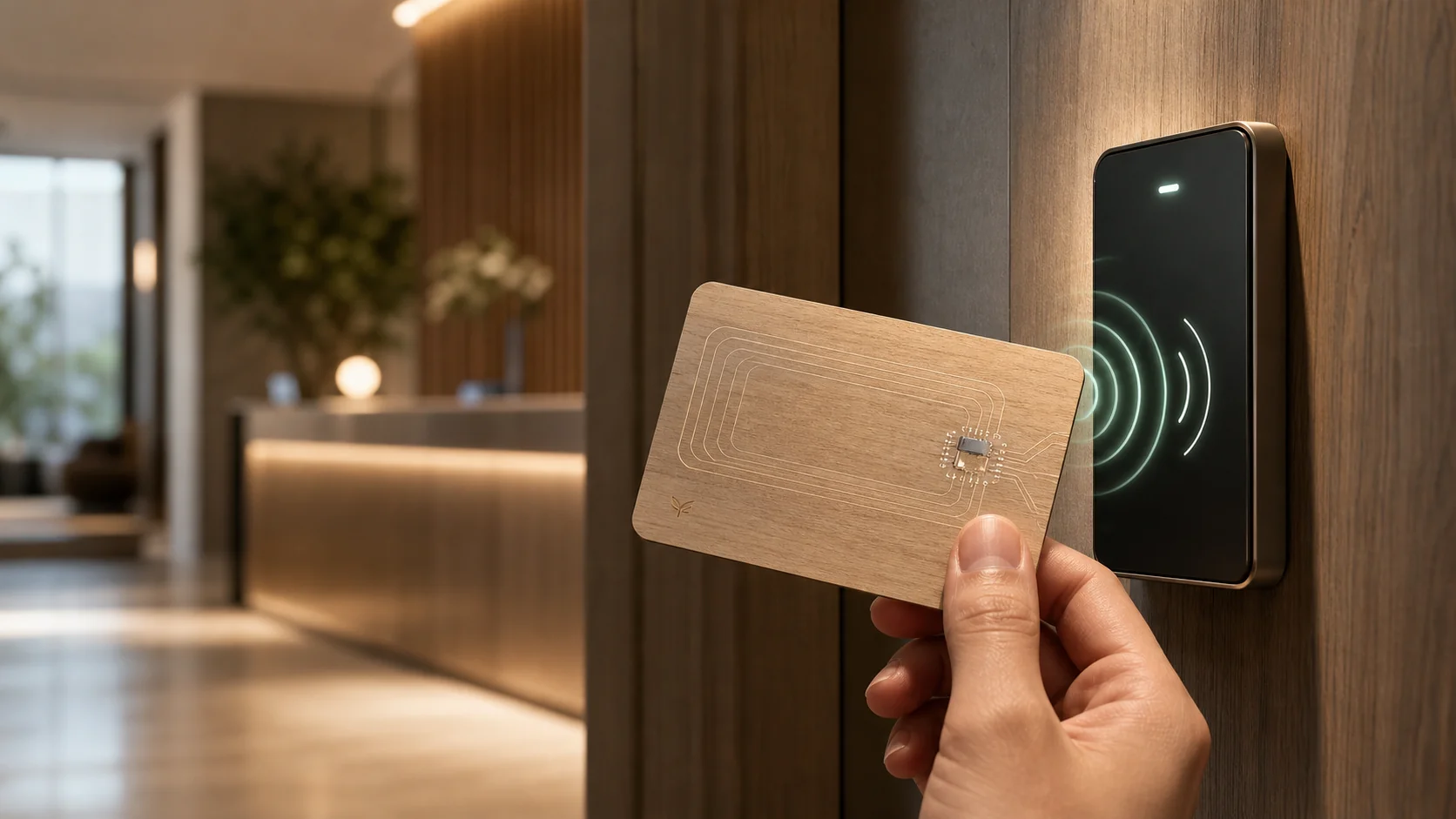
An RFID card is a plastic, wooden, or paper-based card with an embedded microchip and a coiled antenna that lets it communicate with a reader through radio waves — no contact, no battery, no swiping. Tap it near a compatible reader and the chip wakes up, powered by the reader's own electromagnetic field, and exchanges a short burst of data: an ID number, a token, or in higher-security cards, a cryptographically signed response. That tiny exchange is what unlocks a hotel room door, opens a parking gate, charges a vending machine, or logs you into a corporate office.
This guide explains what RFID cards actually are, the three frequency types you'll encounter, the security tiers within them, and how to pick the right one for hotel rooms, access control, transit, or payments. Most modern hotel keys, office badges and transit passes belong to the 13.56 MHz HF smart-card family — covered in detail in the security-tier section below.
Quick Answer
An RFID card is a contactless card with an embedded chip and antenna. It communicates with a reader using radio waves at one of three frequencies — 125 kHz (LF), 13.56 MHz (HF, the most common type for modern hotel keys, contactless payments and access control), or 860–960 MHz (UHF, used for inventory and parking). The 13.56 MHz HF family follows the ISO/IEC 14443 standard for most contactless smart cards and ISO/IEC 15693 for longer-range vicinity cards. The chip stores either a simple ID, encrypted data, or full read/write memory, depending on the security tier.
How RFID Cards Work
Every RFID card has three components hidden between its outer layers:
- A microchip — usually 1–2 mm square, storing the card's unique ID and any application data.
- A coiled antenna — a copper wire loop, etched aluminium spiral, or printed conductive ink, depending on the manufacturing method.
- A substrate — PVC, recycled PVC, FSC-certified wood, biodegradable paper fibre, or polycarbonate.
When the card enters the reader's electromagnetic field (typically 2–10 cm for HF cards, up to several metres for UHF), the antenna picks up energy and powers the chip. The chip transmits its response back through the same antenna. The whole exchange takes between 50 and 500 milliseconds — fast enough that you barely notice the pause when you tap your card.
Crucially, RFID cards are passive: no battery, no maintenance, and a lifespan limited mainly by physical wear on the substrate and the antenna bond. A well-laminated PVC card can survive 100,000+ read cycles.
The Three Frequency Types
RFID isn't a single technology. It's a family of standards split across three frequency bands, each with different range, cost and use cases:
| Frequency | Band | Typical read range | Common uses |
|---|---|---|---|
| 125 kHz | Low frequency (LF) | 2–10 cm | Legacy access control, livestock tags, older hotel locks |
| 13.56 MHz | High frequency (HF) | 2–10 cm | Modern hotel keys, transit, contactless payments, library, NFC |
| 860–960 MHz | Ultra-high frequency (UHF) | 1–12 m | Inventory tracking, supply-chain logistics, vehicle access |
For hotel key cards and most office access systems, the standard today is 13.56 MHz HF. It hits the sweet spot of short, secure read range (so cards can't be skimmed from a distance) and rich data capability (the chip can hold encryption keys, room assignments, and time-bound access tokens).
125 kHz LF cards still exist — usually in older buildings where the lock system hasn't been upgraded. They're cheaper but offer almost no security: the card transmits its ID in cleartext and can be cloned in under a minute with a $20 reader.
Security Tiers in 13.56 MHz Cards
Not all HF cards are equally secure. The chip inside determines what attacks the card can withstand. There are three broad tiers:
Entry-level: UID-only memory cards
The simplest 13.56 MHz cards transmit a unique identifier (UID) and nothing more. Some have a small read-only or rewritable memory area. These are fine for low-stakes use cases — gym lockers, basic loyalty cards, conference badges — but the UID can be cloned easily. If a thief reads your card, they can write the same UID onto a blank card and use it. Most modern public-transit systems and serious access-control deployments have moved beyond this tier for that reason.
Mid-tier: encrypted authentication
These cards use a challenge-response handshake with the reader: the reader sends a random number, the card returns a cryptographic signature proving it knows a shared secret. Without the secret, a cloned UID is useless. This tier is the workhorse of corporate access control and modern hotel locks.
High-security: AES-encrypted with diversified keys
The strongest contactless cards use AES-128 encryption with key diversification — every card has a unique cryptographic key derived from a master key and the card's UID. Cloning a single card doesn't compromise others. Mutual authentication ensures both card and reader prove their identity before any data flows. This tier is what banks, transit systems, and high-end hotel chains use.
If your application carries financial, medical, or safety-critical access, you want this tier. The chip cost difference is a few cents per card; the security difference is several orders of magnitude.
Where RFID Cards Are Used
Hotel key cards
Modern hotel locks moved from magnetic stripe to 13.56 MHz RFID over the past 15 years. Guests tap their card to unlock the room door, dim the lights, draw room balance, or access the gym. Hotel key cards can have plastic, recycled PVC, FSC-certified wood, or bio-fibre bodies. The complete card may also contain an RFID inlay, adhesives and finishes; its end-of-life route depends on the finished construction and local facilities. Reader performance depends on the selected chip, antenna, encoding and finished construction; verify a finished sample on the intended reader.
The same card can also carry more than door access: with TAP, our digital guest experience, guests tap their key card with a phone and reach an AI concierge page in 30+ languages — no app download needed.
Building and campus access control
Offices, hospitals, factories and universities use RFID cards as the primary credential for door access, parking gates, secure storage rooms and time-and-attendance terminals. Higher-security buildings layer biometrics or PIN entry on top of the card.
Contactless payments and closed-loop wallets
Transit cards (London Oyster, Paris Navigo, Hong Kong Octopus), university dining cards, and corporate cafeteria cards all use 13.56 MHz RFID with stored balance or a token tied to a back-office wallet. The card holds the credential; the actual money lives on the server.
Loyalty, membership and events
Hotel groups, casinos, ski resorts, festivals and theme parks issue RFID cards or wristbands as the all-in-one identifier for entry, drinks tab, locker access and ride credit. The chip stores the wallet token; everything else happens in the backend.
Library and asset tracking
Libraries use 13.56 MHz tags inside book covers for self-checkout and anti-theft. Hospitals and clinics tag medical equipment to track location and maintenance history.
How to Choose the Right RFID Card
Three decisions drive the right choice:
- Match the reader's frequency. An HF card won't work at an LF reader and vice versa. Check the lock or access system spec first — most modern systems are 13.56 MHz HF, but legacy 125 kHz installations are still around.
- Pick the security tier that matches the risk. Hotel room access at a 4-star property: encrypted authentication is enough. Bank vault or private clinic: AES-encrypted with key diversification. Gym locker: UID-only is fine and cheaper.
- Choose the substrate. PVC is cheap and durable. Recycled PVC is the same durability with a lower carbon footprint. FSC-certified wooden cards deliver a premium tactile experience and align with sustainable hospitality goals. A bio-fibre card body does not establish biodegradability of the complete credential; confirm the full materials specification and local end-of-life route. Reading performance depends on the chip, antenna, encoding and finished construction; verify a finished sample on the specified reader.
For most B2B buyers, the right card is a 13.56 MHz HF card with encrypted authentication, in a material that matches the brand. Talk to our team for sample sets and platform compatibility checks.
Frequently Asked Questions
Are RFID cards the same as NFC cards?
NFC is a subset of 13.56 MHz HF RFID with two-way communication. Every NFC card is an RFID card, but not every RFID card is NFC. NFC adds the ability for smartphones to read or emulate the card. See our full RFID vs NFC comparison.
How far can an RFID card be read?
It depends on frequency. 13.56 MHz HF cards (the most common type for hotel keys and access control) read at 2–10 cm. 125 kHz LF cards are similar. UHF cards (860–960 MHz) used in inventory tracking can be read at 1–12 metres. Short range is a feature, not a bug — it prevents drive-by skimming.
Can hotel RFID key cards get wet?
Hotel key cards can be treated to resist moisture and brief water exposure, with the chip encapsulated in the card body. Water tolerance depends on the finished construction, bonding materials and coating. Confirm suitability for pool water, light rain, brief immersion, prolonged submersion or hot tub use through the applicable exposure evidence and finished-sample testing under the intended conditions.
Can RFID cards be cloned?
UID-only cards can be cloned in seconds with a cheap reader. Encrypted-authentication cards are far harder — possible with sophisticated equipment but impractical for casual attackers. AES-encrypted cards with diversified keys are not practically cloneable under normal commercial attack models — defeating them typically requires lab-grade equipment, time, and expertise well beyond what an opportunistic attacker has.
Do RFID cards expire?
The chip itself doesn't expire — it has no battery. The card expires when the backend system invalidates the access token (when a hotel guest checks out, an employee leaves, or a transit pass runs out of balance). Physical wear on the substrate and antenna bond is the usual lifetime limit; well-made PVC cards last 100,000+ reads.
What's the difference between RFID and a magnetic stripe?
Magnetic stripe cards store data in iron-oxide stripes that have to be physically swiped through a reader's slot. RFID cards transmit data wirelessly through an antenna and chip. RFID is faster, more durable (no friction wear), can be re-encoded without a slot, and supports far stronger encryption.
Are RFID cards safe to carry?
Yes. RFID cards transmit nothing until they're inside a reader's electromagnetic field. They don't broadcast continuously, they don't track location, and they have no battery. Skimming attacks need close physical proximity and only work against unencrypted cards — encrypted cards return nothing useful even if intercepted.
How much does an RFID card cost?
Per-unit cost depends on chip security tier, substrate, print finish and order volume. Entry-level cards are inexpensive at scale; encrypted-authentication and AES-encrypted high-security cards cost more, with the chip family driving most of the difference. Premium wooden or bio-fibre substrates add a small materials premium. Pricing is project-specific — request a quote with your specs for an accurate figure.
Where to Next
If you're evaluating RFID cards for a specific use case, start with the matching guide:
- Hotel key cards — materials, sizes, lock-system compatibility
- Wooden RFID key cards — wooden card body; request FSC documentation where certification is specified
- Wooden RFID wristbands — events, resorts, festivals
- RFID vs NFC — frequency, range, when to use each
Or talk to our team for samples and a compatibility check for your reader system.