
Last updated: February 2026
Wooden hotel key cards are no longer a novelty. Across the luxury and upper-upscale segments, properties are replacing standard PVC key cards with FSC-certified wood alternatives built around the same RFID chips and lock protocols their existing systems already use. The shift is property-driven, not chain-mandated, but it is accelerating. Below is a detailed breakdown of which brands are switching, what the cards actually cost, how they are manufactured, and where the real limitations are.
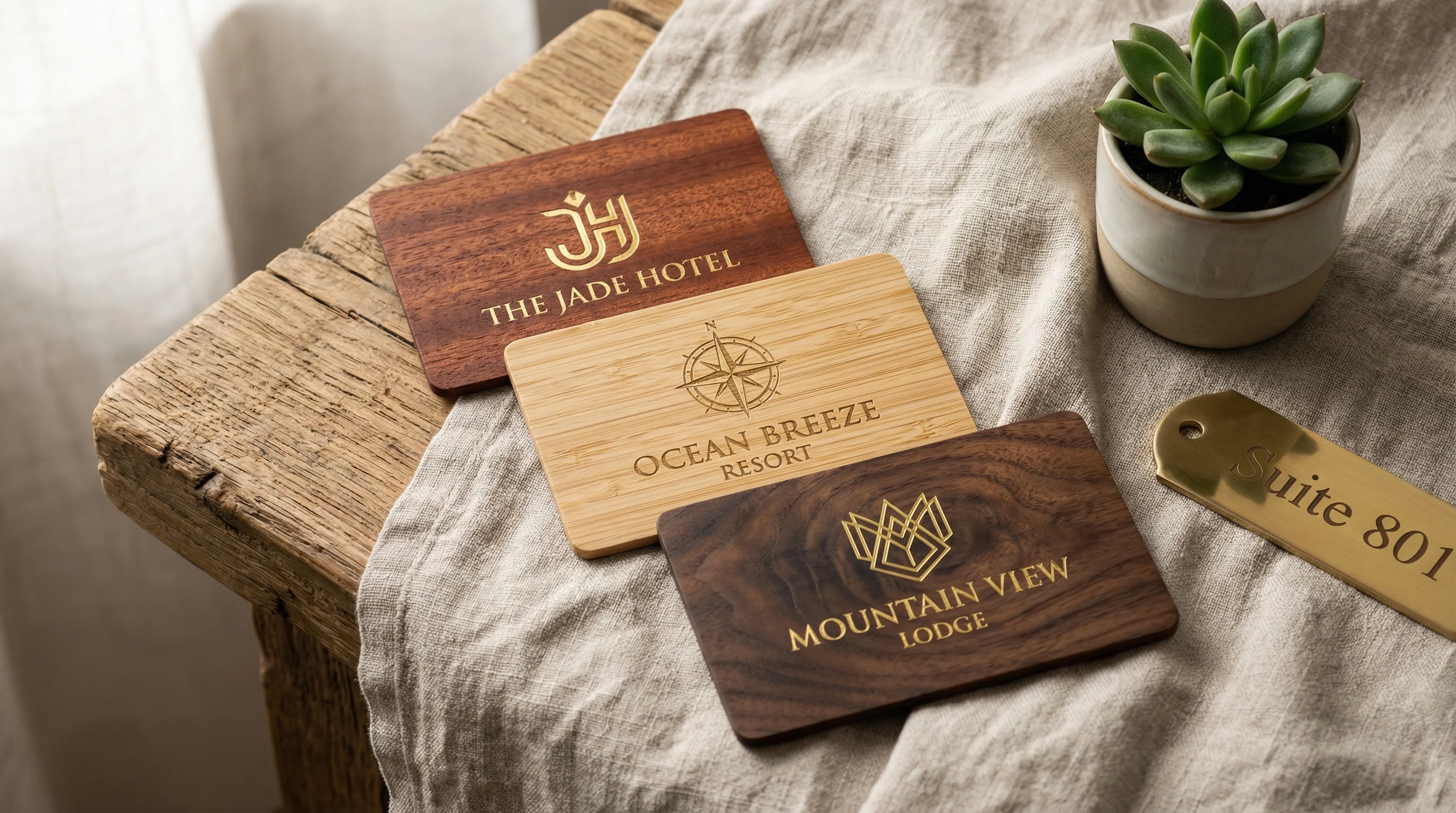
FSC-certified wooden RFID key card with laser-engraved branding -- compatible with all major hotel lock systems
Which Hotels Use Wooden Key Cards in 2026
Adoption is happening at the individual property and regional level. No major chain has issued a global mandate for wooden key cards yet, but the list of users is growing each quarter. Below are brands and properties using wooden key cards as of early 2026. Brands marked with an asterisk (*) are confirmed PrintPlast supply partners.
| Brand / Property | Region | Material | Notes |
|---|---|---|---|
| Four Seasons (select properties) * | Global | Basswood, Cherry | Multiple properties across 3 continents |
| Six Senses (select properties) * | Global | Beech, Bamboo | Aligned with Earth Lab sustainability platform |
| Soho House * | Global | FSC Wood | Members-only clubs worldwide |
| Aman Resorts (select properties) * | Asia-Pacific | Walnut, Cherry | Ultra-luxury positioning |
| Mandarin Oriental (select properties) * | Global | Cherry, Basswood | Luxury brand differentiation |
| 1 Hotel (select properties) | Americas | Various | Sustainability-first brand identity |
| Accor (luxury portfolio) | Europe | Birch, Basswood | Raffles, Fairmont, Sofitel properties |
The common thread is luxury positioning. Properties charging $400+ per night are the earliest adopters because wooden key cards serve double duty: sustainability compliance and brand differentiation. At that price point, the per-card premium is negligible against room revenue.
Why Hotels Are Replacing Plastic Key Cards With Wood
The shift to eco-friendly hotel key cards is driven by four converging pressures: regulatory compliance, guest expectations, brand positioning, and genuine waste reduction. Here is how each factor plays out in practice.
ESG and Sustainability Certification
GSTC (Global Sustainable Tourism Council) certification now requires measurable plastic reduction targets. IHG's "Journey to Tomorrow" program specifically identifies single-use plastics as a priority elimination category. Wooden RFID cards offer a visible, auditable reduction that shows up in annual sustainability reports.
Guest Preference Data
Booking.com's 2025 Sustainable Travel Report found that 70% of travelers actively prefer eco-friendly accommodations. Sustainable hotel key cards serve as an immediate, tangible signal at check-in -- the first physical object a guest touches. That first impression carries disproportionate weight in post-stay reviews.
Luxury Brand Differentiation
A wooden key card has a fundamentally different tactile quality than PVC. The grain, the weight, the warmth -- these register subconsciously as "premium" in a way that even the best-printed plastic card cannot replicate. Dorado Beach (Ritz-Carlton Reserve) reported that guests actively collect their wooden cards as souvenirs, an organic marketing channel that costs the property nothing beyond the card itself.
Measurable Waste Reduction
Industry estimates suggest the hotel sector generates approximately 520,000 tons of PVC key card waste annually from an estimated 2.6 billion cards in circulation. Every 1 million cards replaced with FSC-certified wood prevents roughly 5 tons of plastic from entering the waste stream. If 15% of high-end hotels complete the switch, the aggregate carbon reduction would exceed 120,000 tons per year -- equivalent to the annual carbon capture of 6.7 million fir trees.
"A single FSC basswood key card reduces emissions by 61 grams compared to its PVC equivalent. Multiply that across 2.6 billion annual cards, and the arithmetic becomes difficult to ignore."
How Wooden Key Cards Are Made
Manufacturing wooden RFID cards is more complex than producing standard PVC cards. The process requires precision lamination to protect the embedded electronics while maintaining the natural look and feel of real wood. Here is the construction breakdown from our production floor:
5-Layer Cross-Grain Laminated Construction
Each card consists of five thin wood veneers laminated with alternating grain directions. The RFID inlay -- antenna and chip -- is sandwiched between the third and fourth layers. Cross-grain lamination serves two purposes: it prevents warping across humidity changes, and it distributes mechanical stress evenly so the card resists cracking under normal use.
Wood Species Options
The choice of wood affects appearance, durability, and cost:
- Bamboo -- lightest color, highest sustainability credentials (grass, not hardwood), excellent dimensional stability
- Basswood -- fine grain, easy to engrave, most cost-effective FSC option
- Birch -- light tone, strong for its weight, widely available FSC-certified
- Cherry -- warm reddish tone, darkens naturally over time, mid-range pricing
- Walnut -- rich dark color, premium positioning, highest material cost
- Maple -- very tight grain, excellent for detailed laser engraving
- Beech -- uniform texture, good moisture resistance among hardwoods
RFID Chip Compatibility
Wooden cards use the same 13.56 MHz (ISO 14443-A) RFID chips as standard PVC cards. Supported chip types include:
- Standard RFID 1K / 4K
- Encrypted RFID
- Advanced encrypted RFID (AES-128)
- NFC 213 / 215 / 216
This matters because it means zero lock system changes are required. Wooden key cards are compatible with all major hotel lock platforms. A property can switch from PVC to wood without touching its existing access control infrastructure.
Signal Performance: Wood vs. PVC
A common concern is whether wood interferes with RFID signal transmission. It does not, in any meaningful way. Dry wood has a dielectric constant of 2.0-4.0, which is extremely close to PVC at 2.5-3.0. In practical terms, there is no perceptible difference in read range or reliability between a wooden card and a PVC card on the same lock system.
Design and Finishing
Wooden cards are finished using laser engraving and UV printing. Laser engraving burns the design directly into the wood surface, producing a permanent mark that cannot wear off. UV printing adds color where needed. Biodegradable coatings and natural waxes protect the surface from moisture and handling wear without introducing synthetic materials to the card body.
Wooden Key Card vs Plastic: Full Cost Comparison
The price gap between wooden and plastic RFID key cards is real and significant. Here is what each option costs at typical order volumes:
| Card Type | Price per Unit | Typical MOQ | Best For |
|---|---|---|---|
| Standard PVC RFID | $0.15 - $0.50 | 500 | Budget properties, high volume |
| Recycled PVC RFID | $0.20 - $0.60 | 500 | Sustainability at standard cost |
| PPH BioBoard | $0.25 - $0.70 | 500 | Bio-based alternative, PVC-like feel |
| Wooden RFID (bamboo/basswood) | $0.80 - $2.00 | 200 | Eco-luxury positioning |
| Wooden RFID (walnut, engraved) | $2.00 - $5.00 | 200 | Ultra-luxury, souvenir value |
The 3-10x cost premium is the single biggest barrier to adoption. But context matters. For a 200-room hotel ordering 5,000 cards per year, upgrading from standard PVC ($0.30) to bamboo ($1.20) adds $4,500 annually. Against a property generating $10M+ in room revenue, that is 0.045% of top-line income -- and it buys measurable ESG compliance, guest differentiation, and social media coverage.
For a more granular analysis of key card economics, see our hotel key card cost breakdown.
The Honest Limitations of Wooden Key Cards
No product is perfect, and wooden hotel key cards have real trade-offs that procurement teams need to evaluate. We manufacture both PVC and wooden cards, so we see both sides clearly.
Thickness
Wooden cards measure 0.8-1.45mm thick versus the ISO standard 0.76mm for PVC. Most modern hotel lock encoders handle this without issue, but some older encoder models with tight card slots may require adjustment or replacement. Always test with your specific hardware before ordering at volume.
Print Quality
Wood grain is visible through any printing process. Full-color photographic CMYK reproduction is limited compared to PVC's smooth, white surface. The standard approach is laser engraving for primary branding combined with UV printing for accent colors. This produces a distinctive, premium look -- but it is not the same as four-color offset printing on plastic.
Moisture Sensitivity
Wood absorbs moisture. In tropical or high-humidity environments (Caribbean, Southeast Asia, pool areas), untreated wooden cards can swell or warp. Waterproof coatings and natural wax treatments mitigate this effectively, but they add a processing step and a thin cost increase. Properties in tropical climates should specify marine-grade coating at the order stage.
Flexibility
PVC cards flex and return to shape. Wood does not. A wooden card in a back pocket can crack if the guest sits on it at the wrong angle. This is a behavioral factor, not a defect, but it does generate occasional replacements. The souvenir effect partly offsets this: guests who treat the card as a keepsake handle it more carefully than a disposable plastic card.
The E-Waste Reality
This is the nuance that most marketing materials skip. The wood shell is biodegradable. The RFID chip and copper antenna inside it are not. "Biodegradable hotel key card" is accurate for the body material, but the electronics component remains e-waste that requires proper disposal. Full lifecycle honesty is important here, and hotels should communicate this accurately to guests rather than claiming the card is 100% compostable.
Wooden Hotel Key Cards and Lock System Compatibility
Wooden RFID key cards work with every major hotel lock system on the market today. No firmware updates, no hardware swaps, no reprogramming. The card presents the same 13.56 MHz signal as PVC because the internal RFID inlay is identical.
Confirmed compatible lock systems:
All major electronic lock manufacturers support standard 13.56 MHz RFID cards, and wooden cards present the same signal. Whether your property uses offline, online, or mobile-enabled locks, wooden key cards are a drop-in replacement for PVC with no reconfiguration needed.
For properties currently using magnetic stripe systems, the switch to wooden key cards also represents an opportunity to upgrade to RFID simultaneously, improving both security and sustainability in one procurement cycle.
The Souvenir Effect: Why Guests Keep Wooden Key Cards
One of the unintended benefits of wooden hotel key cards is that guests take them home. Intentionally. Dorado Beach, Ritz-Carlton Reserve was among the first to document this behavior: guests treat the card as a travel memento rather than something to drop in the checkout box.
For hotels, this has three practical implications:
- Higher card turnover -- budget for 15-25% more cards annually than PVC replacement rates
- Organic brand exposure -- a wooden card on a desk or in a wallet is a conversation starter that no digital ad can replicate
- Social media content -- guests photograph and post wooden key cards at significantly higher rates than plastic, generating earned media
The souvenir effect turns what appears to be a cost (higher replacement rate) into a marketing asset with measurable returns.
FSC Certification and Environmental Standards
FSC (Forest Stewardship Council) certification is the baseline standard for sustainable hotel key cards made from wood. It verifies that the raw material comes from responsibly managed forests with documented chain-of-custody tracking from forest to finished product.
Beyond FSC, leading wooden key card manufacturers also comply with:
- REACH regulations -- EU chemical safety, including formaldehyde emission limits for laminated wood products
- RoHS -- restriction of hazardous substances in the RFID electronics
- ISO 14001 -- environmental management system certification at the production facility
Hotels pursuing GSTC certification or preparing for the EU Corporate Sustainability Due Diligence Directive (CSDDD) should request complete chain-of-custody documentation from their card supplier. The certification papers are as important as the product itself when auditors arrive.
Frequently Asked Questions
How much do wooden hotel key cards cost compared to plastic?
Standard PVC RFID key cards cost $0.15-$0.50 per unit. Wooden RFID key cards range from $0.80-$3.50 depending on wood species and finishing. Premium walnut with laser engraving reaches $2.00-$5.00 per card. The typical premium is 3-10x over standard PVC, though higher order volumes bring the gap down.
Do wooden key cards work with existing hotel door locks?
Yes. Wooden RFID key cards use the same 13.56 MHz chips as PVC cards. They are compatible with all major hotel lock systems with no hardware or software changes required.
Are wooden key cards really biodegradable?
The wood shell is biodegradable and compostable. However, the RFID chip and copper antenna embedded inside are electronic components that qualify as e-waste. Hotels should be transparent that "biodegradable" applies to the card body, not the entire unit. Proper disposal separates the electronics from the wood.
Which hotel chains currently use wooden key cards?
As of early 2026, confirmed users include Four Seasons, Six Senses, Soho House, Aman, Mandarin Oriental, and select Accor luxury properties (Raffles, Fairmont, Sofitel). Adoption is at the property level, not chain-wide mandates.
What wood types are used for hotel key cards?
The most common species are bamboo, basswood, birch, cherry, walnut, maple, and beech. Bamboo offers the strongest sustainability credentials as a rapidly renewable grass. Walnut commands the highest premium for its dark color and luxury positioning. Basswood is the most cost-effective FSC-certified option.
Do wooden key cards have signal or read range issues?
No. Dry wood has a dielectric constant of 2.0-4.0, nearly identical to PVC at 2.5-3.0. There is no measurable difference in RFID read range or reliability between wooden and PVC cards on the same lock system. The signal passes through wood as effectively as it passes through plastic.
Why do hotel key cards stop working -- does wood make it worse?
Key cards fail due to magnetic interference, chip damage, or encoding errors -- not the card body material. Wood does not increase failure rates. For a full breakdown of failure causes and prevention, see our guide on why hotel key cards stop working.
About PrintPlast
PrintPlast manufactures RFID key cards, wristbands, and access control products for hotels, resorts, and private clubs worldwide. Our wooden key card line uses FSC-certified wood with 5-layer cross-grain lamination and is compatible with all major hotel lock systems. We supply Four Seasons, Soho House, Six Senses, Aman, and hundreds of independent luxury properties.
Switch to Wooden Key Cards
Request samples, pricing, or technical specifications for your property. We manufacture bamboo, basswood, cherry, walnut, and birch RFID key cards compatible with your existing lock system.
Contact: info@printplast.com
Products: Wooden Key Cards · PPH BioBoard
Related: Mobile Key vs Key Card · Key Card Cost Breakdown · RFID vs Magstripe Security