
Published: July 2026
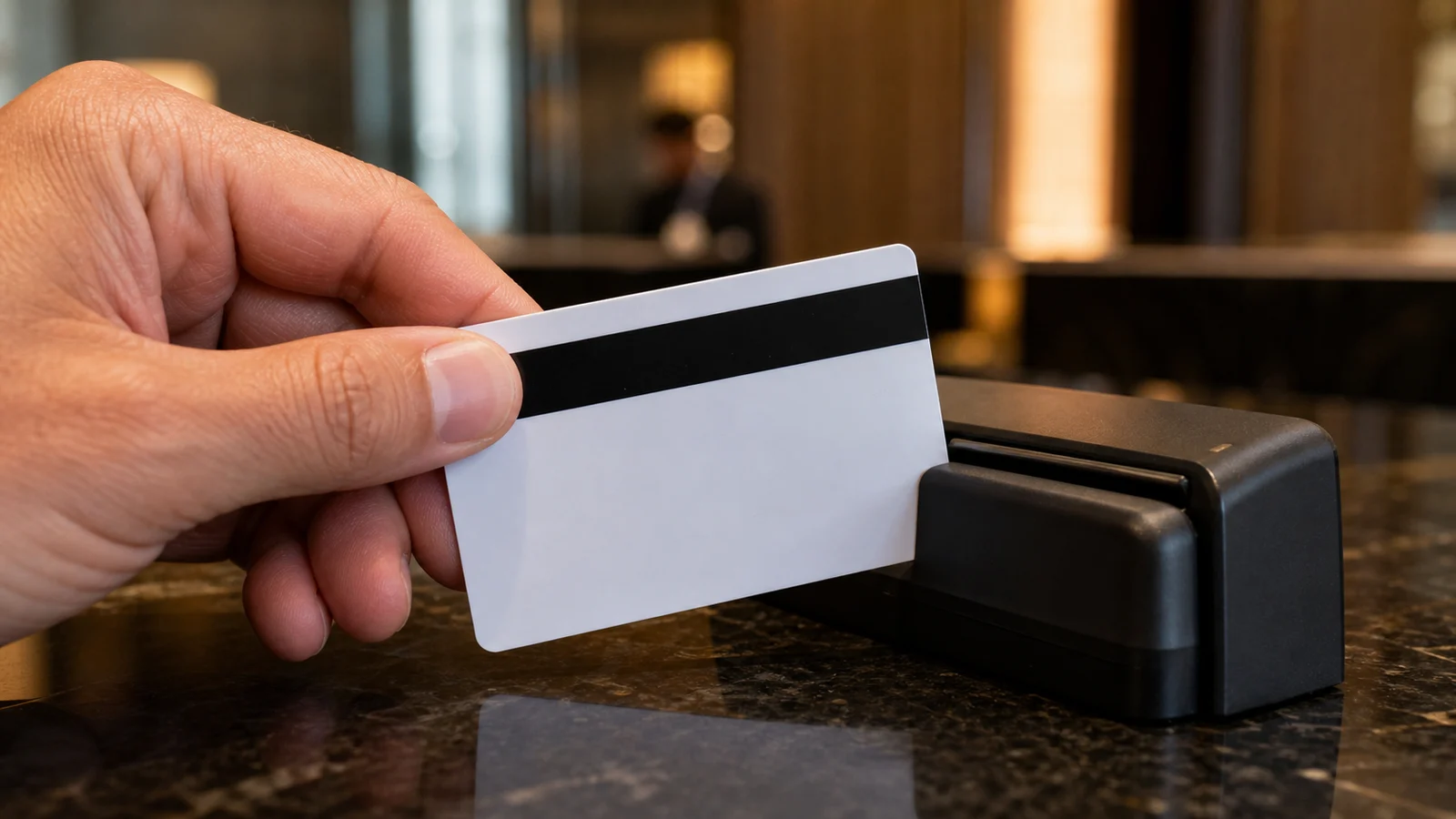
Your key card worked this morning. Now the lock blinks red, and someone in your group says the word every traveler has heard: demagnetized. Here is the short version: you cannot remagnetize a hotel key card yourself, and no phone app, magnet, or rubbing-it-on-your-jeans trick will bring it back. Ask the front desk to check the card and re-encode or replace it; timing depends on the system, card condition and hotel procedure. For hotel operators, the entire problem is optional. This guide covers what actually happens when a card "demagnetizes," how to get it fixed fast, and how hotels eliminate the failure category completely.
Do Hotel Key Cards Really Demagnetize?
Yes, but only the magnetic stripe kind, and less often than people think. A magstripe key card stores your access code in millions of tiny magnetic particles. A strong enough external magnetic field can scramble those particles, wiping the data. When that happens the card is not damaged. It is blank, like an erased cassette tape.
RFID key cards, the tap-style cards used by most modern hotels, cannot be demagnetized at all. They store data in a silicon chip, not magnetic particles. If your tap card stops working, the cause is expiration, a re-encoding mix-up at the desk, or a dead lock battery, not magnets. Our guide to why hotel key cards stop working walks through all seven failure causes.
What Actually Demagnetizes a Magstripe Card
- Magnetic phone case clasps and purse closures: the #1 real-world culprit. The clasp sits directly against the card for hours.
- A second magstripe card stored face-to-face: credit cards and key cards can interfere with each other in a tight wallet.
- Magnetic money clips and bag magnets
- Induction chargers and speaker magnets, with prolonged direct contact.
What Does NOT Demagnetize Your Card
- Your phone itself. A smartphone's electromagnetic field is far too weak. It is the magnetic case clasp, not the phone, that kills cards.
- Airport security scanners. X-ray machines and metal detectors do not affect magnetic stripes.
- Simply being in your pocket. Body heat and normal handling do nothing.
How to Fix a Demagnetized Key Card: What Actually Works
- Try the card a few more times, slower. Dirty reader heads cause more "demagnetized" verdicts than actual demagnetization. Vary your swipe speed.
- Take it to the front desk. Re-encoding writes fresh data onto the stripe in seconds. Say "duplicate key" rather than "new key" if others in your room still have working cards. A "new key" silently cancels theirs.
- If it keeps happening, ask the front desk to inspect the card. Stripe damage, contamination and reader or encoder condition can affect reliability. Use inspection and read/write checks rather than a fixed re-encode count; replace cards that fail those checks.
- Check what is in your pocket. If your card dies daily, a magnetic clasp is almost always the reason. Keep the card in its paper sleeve, away from your phone case.
And the myths, tested so you don't have to: rubbing the card on fabric does nothing. Household magnets make it worse. No phone app can rewrite a magnetic stripe. There is no DIY remagnetizer. An authorized hotel encoder writes the credential data required by the installed access system onto the stripe. Ask the front desk to verify the booking and re-encode or replace the card using that system’s approved procedure.
For Hotels: How to End Demagnetization Complaints Permanently
If your front desk re-encodes cards all day, you have a materials problem, not a guest problem. Three fixes, in ascending order of impact:
- Switch to HiCo magstripe stock. High-coercivity stripes are roughly 9× more resistant to magnetic fields than standard LoCo stock, for pennies more per card.
- Hand out sleeves and train the "duplicate vs new key" distinction. The two cheapest complaint-reducers in hospitality.
- Upgrade to RFID key cards. RFID authentication does not rely on a magnetic stripe. Reader compatibility, antenna damage and credential configuration still matter. Specify RFID hotel key cards for the intended reader, test a finished sample and agree the inspection plan. Review custom printing against the approved artwork and construction.
Properties that make the switch typically find the per-card premium pays for itself in fewer front-desk interruptions, fewer replacement cards, and better guest review scores. A demagnetized card at 11pm is exactly the kind of small failure that ends up in a TripAdvisor paragraph.
Frequently Asked Questions
Can you remagnetize a hotel key card?
A magnetic field can alter the encoded data on a magnetic stripe; it does not restore the authorized hotel credential. Ask the front desk to verify your booking and use the approved encoder to re-encode or replace the card. Rubbing the card or using a household magnet does not recreate the correct credential.
Will my phone demagnetize my hotel key card?
The phone itself, no. Its electromagnetic field is far too weak. Magnetic phone case clasps, however, are the single most common cause of wiped key cards. Keep the card out of the case flap and in its paper sleeve.
Why does my key card keep demagnetizing every day?
Repeat failures usually are not demagnetization. Suspects, in order: a magnetic clasp in your pocket or bag, damaged or contaminated card stock, a dirty encoder at the desk producing weak writes, or a property system that silently invalidates cards when your reservation changes. Ask the desk for a fresh card and mention the pattern.
Can RFID hotel key cards be demagnetized?
RFID authentication stores data in a chip rather than relying on magnetic-stripe encoding. A finished card may also include a magnetic stripe; no visible stripe does not by itself establish RFID. Ask the hotel to confirm the credential and intended reader. If contactless access fails, check the permissions, encoding, reader and complete card condition. See our full guide to why hotel key cards stop working.