
Last updated: February 2026
The security gap between RFID vs magstripe hotel key cards is no longer a matter of debate. Magnetic stripe cards store data in plaintext on ferromagnetic particles with zero encryption, making them clonable in under 30 seconds with equipment costing as little as $20. RFID key cards operating at 13.56 MHz store data on silicon microchips with layered encryption, mutual authentication, and anti-cloning protections. However, not all RFID chips are created equal, and several high-profile vulnerabilities have exposed critical weaknesses in older RFID standards as well.
This article provides a technical comparison of both technologies, documents every major hotel key card vulnerability through 2026, and offers a clear migration framework for properties still running magnetic stripe systems.
RFID vs Magstripe Hotel Key Card: How the Technology Works
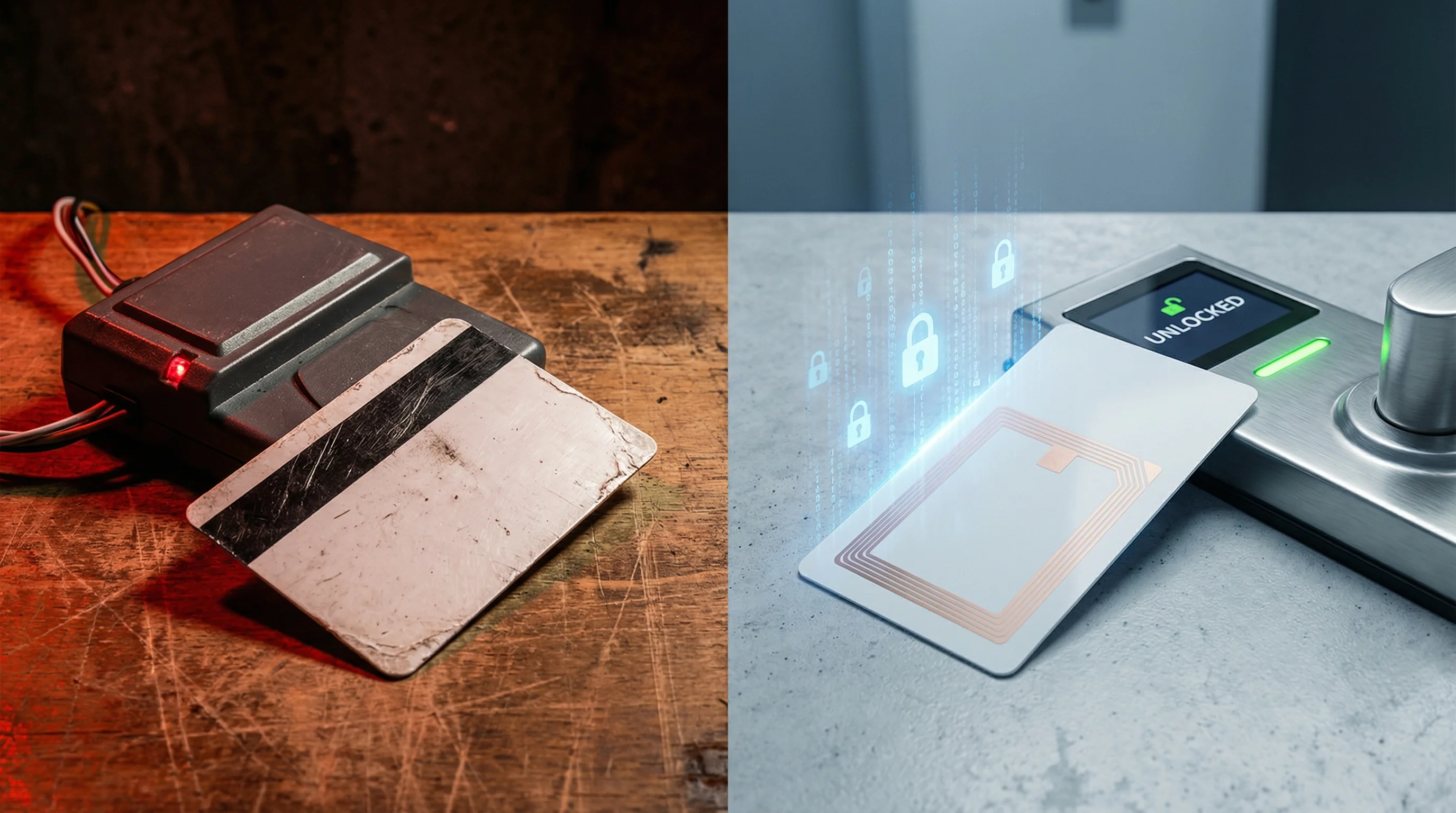
Magnetic stripe cards encode data onto a strip of ferromagnetic particles arranged in three tracks. The data is static, unencrypted, and readable by any device with a magnetic read head. RFID hotel key cards use a silicon microchip powered by the electromagnetic field of the door lock reader, operating at 13.56 MHz (ISO 14443-A). The chip communicates via radio waves using encrypted challenge-response protocols, and the data changes with each authentication session on modern implementations.
| Feature | Magnetic Stripe | RFID (13.56 MHz) |
|---|---|---|
| Data storage | Ferromagnetic particles (plaintext) | Silicon microchip (encrypted) |
| Encryption | None | AES-128, 3DES, or legacy 48-bit cipher (varies by chip) |
| Authentication | None (read-only data) | Mutual authentication (card + reader verify each other) |
| Clone difficulty | Trivial ($20 reader, <30 seconds) | Chip-dependent: trivial for legacy RFID chips, no known method for advanced AES-128 chips |
| Contact type | Swipe (physical contact) | Contactless (proximity) |
| Durability | Degrades with use, demagnetizes near phones | 1 million+ read/write cycles, no physical wear |
| Mobile key support | Not possible | NFC-enabled (smartphone access) |
| Standard | ISO 7811 | ISO 14443-A |
Can Hotel Key Cards Be Cloned?
Yes, but the difficulty depends entirely on the technology. Magnetic stripe hotel key cards can be cloned by anyone with a $20-100 MSR (magnetic stripe reader/writer) device in under 30 seconds. The data is stored in plaintext, so there is no encryption to defeat. RFID hotel key cards range from trivially clonable (legacy RFID chips) to effectively unbreakable with current technology (advanced AES-128 chips), depending on the chip used.
Magstripe cloning
A magnetic stripe reader/writer purchased for $20 to $100 online can read, store, and duplicate the data on any magstripe hotel key card. The entire process takes less than 30 seconds and requires no technical expertise beyond plugging in a USB device. This is not theoretical. Room theft rings have used cloned magstripe cards for over a decade, and a 2012 hack of a widely deployed hotel lock system demonstrated that 4 to 5 million hotel rooms could be opened with a $50 Arduino-based device exploiting port vulnerabilities in magstripe locks.
RFID cloning: chip matters
RFID cloning difficulty varies dramatically by chip generation. Legacy RFID cards using the proprietary 48-bit cipher, which was reverse-engineered by researchers at Radboud University in 2008, can be cloned with a $200-400 RFID cloning device. A Flipper Zero ($170) can also read and emulate many older RFID cards. AES-128 RFID cards (second and latest generation) using AES-128 encryption have no publicly known practical cloning method when properly configured.
Hotel Key Card Hack: Every Major Vulnerability (2008-2026)
Hotel key card security has been breached repeatedly over the past 17 years. Every major incident traces back to either plaintext data storage (magstripe), broken encryption (legacy RFID chips with a proprietary 48-bit cipher), or implementation flaws in lock firmware. Below is a complete timeline of documented vulnerabilities, including CVE numbers where assigned.
2008: Legacy RFID cipher broken
Researchers at Radboud University Nijmegen reverse-engineered the proprietary 48-bit cipher used in legacy RFID chips, proving that these cards could be cloned in minutes. This affected millions of access control systems worldwide. Despite this being public knowledge for over 17 years, legacy RFID chips using this broken cipher remain in active use in hotel lock systems today. Any property still deploying these chips is operating on a cryptographic foundation that has been publicly broken since 2008.
2012: Major hotel lock hack (4-5 million rooms)
Security researcher Cody Brocious demonstrated that a widely deployed hotel lock model, installed in 4 to 5 million hotel rooms globally, could be opened with a $50 Arduino device inserted into the DC port on the bottom of the lock. The attack bypassed the key card entirely by exploiting a firmware vulnerability that exposed the lock's memory contents, including the master key. The lock manufacturer's initial response was to ship plastic port covers rather than issue firmware updates.
2024 (March): Major hotel lock vulnerability (3+ million locks)
Researchers Ian Carroll and Lennert Wouters disclosed a major hotel lock vulnerability affecting 3 million or more locks from a leading lock manufacturer, deployed across 13,000+ properties in 131 countries. The attack requires only one expired key card from any room in the target property plus a $200 RFID cloning device. The attacker creates two forged cards that unlock any door in the property, including deadbolted doors. At disclosure, only 36% of affected locks had been patched.
2024 (August): Third-party RFID chip hardware backdoor
Security researchers discovered a hardware-level backdoor in a widely used third-party RFID chip. The backdoor key can be brute-forced in approximately two minutes, granting full read/write access to all data on the chip. These chips are used in hotel key card systems across the United States, Europe, China, and India. Because the backdoor exists in silicon, no firmware update can fix it. Affected cards must be physically replaced.
2025 (May): Hotel lock master key forgery
A vulnerability documented by security researchers reveals that certain hotel locks store card data in cleartext on legacy RFID chips. An attacker with access to a single guest room card can extract the data and forge a master key card granting access to every room in the property. The fix requires full system replacement because the vulnerability stems from the combination of cleartext storage on a cryptographically broken chip.
Hotel Key Card Encryption: What Actually Protects Guest Rooms
Encryption is the primary factor separating secure hotel key cards from vulnerable ones. Magnetic stripe cards have no encryption at all. Among RFID chips, the encryption standard determines whether a card is practically unbreakable or trivially defeated. Hotels should verify the specific chip and encryption protocol in their lock system, because the brand name on the lock does not guarantee the security level of the card inside it.
| Chip | Encryption | Key Length | Status (2026) | Known Attacks |
|---|---|---|---|---|
| Magnetic Stripe | None | N/A | Obsolete | Trivial cloning ($20) |
| Legacy RFID Chip | Proprietary legacy cipher | 48-bit | Broken since 2008 | Key recovery in seconds |
| Password-Only RFID Chip | None (password only) | 32-bit password | Minimal security | Brute-force feasible |
| 3DES Encrypted RFID Chip | 3DES | 112-bit | Adequate | No practical attacks |
| AES-128 RFID (Gen 1) | AES-128 / 3DES | 128-bit | Secure | No practical attacks |
| AES-128 RFID (Gen 2) | AES-128 | 128-bit | Secure | No practical attacks |
| AES-128 RFID (Gen 3) | AES-128 | 128-bit | Current best | No known practical method |
Advanced AES-128 RFID: Why the Latest Generation Is the Gold Standard
The latest-generation AES-128 RFID chip represents the highest commercially available security for hotel key cards in 2026. It uses AES-128 encryption certified under NIST FIPS 197, implements mutual authentication where both the card and the reader verify each other before data exchange, and includes proximity checking to mitigate relay attacks. There are no publicly known practical attacks against properly configured latest-generation AES-128 deployments.
The critical qualifier is "properly configured." The latest-generation AES-128 chip supports backward-compatible modes that can weaken its security if the lock system does not enforce the full protocol. Hotels upgrading to advanced AES-128 cards should verify with their lock vendor that AES-128 mutual authentication is active, that legacy compatibility modes are disabled, and that proximity checking is enabled.
Hotel Key Card Vulnerability 2026: What Equipment Attackers Use
Understanding the attacker's toolkit helps hotels assess their actual risk exposure. The equipment needed to attack hotel key cards ranges from $20 for magnetic stripe cloning to effectively priceless for advanced AES-128 chips (no known method exists). The accessibility and low cost of magstripe attack tools is the primary reason hotels should treat magnetic stripe systems as an immediate security liability.
| Attack Tool | Cost | Target | Skill Required |
|---|---|---|---|
| MSR reader/writer | $20 - $100 | Magnetic stripe cards | Minimal (plug-and-play) |
| Flipper Zero | $170 | Low-frequency RFID, some NFC | Low to moderate |
| RFID cloning device | $200 - $400 | Legacy RFID chips, hotel lock exploits | Moderate |
| Full legacy RFID attack kit | $300 - $500 | Any legacy-encrypted system | Moderate |
| AES-128 RFID attack | N/A | N/A | No known practical method |
Magstripe vs RFID Cost Comparison Hotel: Migration Economics
Cost is the most commonly cited reason hotels delay migrating from magnetic stripe to RFID key card systems. A magstripe lock typically costs $25 to $50 per door, while an RFID lock ranges from $150 to $600 per door depending on the manufacturer and feature set. For a 200-room hotel, the hardware difference is roughly $25,000 to $110,000. However, this comparison ignores the cost of security incidents, insurance, and operational savings.
| Cost Factor | Magnetic Stripe | RFID |
|---|---|---|
| Lock hardware (per door) | $25 - $50 | $150 - $600 |
| Card cost (per unit) | $0.10 - $0.30 | $0.30 - $2.00 |
| Card replacement rate | High (demagnetization, wear) | Low (no contact wear) |
| Mobile key capability | Not possible | NFC-enabled options available |
| Insurance premium impact | Increasing (known vulnerability) | Favorable (modern security) |
| Liability exposure | High (premises liability risk) | Reduced (demonstrated due diligence) |
| Guest experience | Swipe failures common | Tap-and-go, smartphone option |
The hidden cost of inaction
In 2022, a hotel chain faced settlements exceeding $2 million after a series of room thefts were traced to cloned magnetic stripe key cards. The property also experienced an estimated 15% decline in bookings following media coverage of the incidents. Insurance carriers are increasingly factoring access control technology into their underwriting decisions for hospitality properties. Hotels using lock systems with documented, unpatched vulnerabilities may face negligence claims under premises liability law if a guest's belongings or safety are compromised.
RFID Chip Security: Why Not All RFID Cards Are Equal
Migrating from magnetic stripe to RFID is necessary but not sufficient. The RFID label covers a wide spectrum of security levels, and some RFID chips are almost as vulnerable as magstripe. The legacy RFID chip, the most widely deployed RFID chip in hotel locks, uses a proprietary 48-bit cipher that has been publicly broken since 2008. A hotel that upgrades from magstripe to a legacy RFID chip has improved durability and convenience but has not meaningfully improved security against a motivated attacker.
The minimum acceptable RFID security standard for hotel key cards in 2026 is a 3DES encrypted RFID chip (112-bit encryption) or an AES-128 RFID chip (first generation and above). Properties installing new lock systems should specify second or latest-generation AES-128 chips to ensure protection against current and foreseeable attack methods.
Are RFID Hotel Key Cards Secure?
RFID hotel key cards using second or latest-generation AES-128 chips with AES-128 encryption are the most secure commercially available option for physical room access in 2026. No practical attack against properly configured AES-128 RFID systems has been publicly demonstrated. However, RFID cards using older legacy chips have well-documented vulnerabilities that have been exploited in real-world hotel breaches. The answer depends entirely on which RFID chip is inside the card.
Hotels should ask their lock vendor three specific questions: (1) What chip is in our key cards? (2) What encryption protocol is active? (3) Are legacy compatibility modes disabled? If the vendor cannot answer these questions clearly, that itself is a security concern.
Migration Guide: Magstripe to RFID Hotel Key Cards
For properties still operating on magnetic stripe or legacy RFID chips, migration to a modern RFID system should be treated as a security upgrade with a defined timeline rather than an optional future project. Approximately 74% of hotels globally have already implemented RFID systems. No major lock manufacturer is developing new magstripe-only products. The remaining 26% of properties face increasing security risk, rising insurance scrutiny, and growing guest expectations for contactless access.
Step 1: Audit your current system
Identify the exact chip and encryption in your current key cards. Your lock vendor or card supplier can confirm this. If you are running legacy RFID chips with a 48-bit cipher, you are operating on broken cryptography regardless of the lock brand.
Step 2: Specify AES-128 RFID (second or latest generation)
When evaluating RFID lock systems, require AES-128 encryption with mutual authentication. Do not accept legacy RFID chips as a default. Most major lock vendors offer AES-128 compatible systems.
Step 3: Phase the rollout
Most lock vendors support phased migration where new RFID locks are installed floor-by-floor alongside existing systems. This reduces upfront cost and minimizes operational disruption. Prioritize high-value areas: suites, executive floors, and any rooms accessible from public corridors.
Step 4: Verify configuration
After installation, confirm with the vendor that AES-128 mutual authentication is active, that legacy/backward-compatible modes are disabled, and that firmware is on the latest version. Request documentation of these settings.
Step 5: Establish an update protocol
The 2024 hotel lock vulnerability incident demonstrated that even modern lock systems require firmware updates. Establish a process for applying vendor security patches within a defined timeframe, not as an indefinite future task.
Industry Direction: Where Hotel Key Card Security Is Heading
The hospitality industry is converging on three access technologies: RFID key cards (AES-128 encrypted, second and latest generation), NFC-enabled mobile keys via smartphone apps, and hybrid systems supporting both. Major chains including Marriott, Hilton, IHG, and Accor specify exclusively RFID or mobile key systems for all new-build properties. Magnetic stripe is no longer part of any major chain's forward technology roadmap.
Mobile key adoption is accelerating but has not replaced physical cards. Guest adoption rates vary by market, and hotels need physical backup cards for guests without compatible smartphones, for group check-ins, and for secondary cards. The physical hotel key card remains essential infrastructure, and the security of that card depends on the chip technology inside it.
Frequently Asked Questions
How do hotel key cards work?
Hotel key cards store a digital credential that the door lock reads and verifies. Magnetic stripe cards encode this data on a magnetized strip that the lock reads via physical swipe. RFID cards store encrypted data on a microchip that communicates wirelessly with the lock reader when held within a few centimeters. The lock compares the credential against its authorized access list and either grants or denies entry. Modern RFID systems use challenge-response authentication where both the card and lock verify each other before opening.
How to clone a hotel key card?
Magnetic stripe hotel key cards can be cloned with a $20-100 MSR reader/writer in under 30 seconds. The device reads the plaintext data from the magnetic stripe and writes an identical copy to a blank card. Legacy RFID cards can be cloned with an RFID card reader device ($200-400) by exploiting the broken 48-bit cipher. AES-128 RFID cards (second and latest generation) using AES-128 encryption have no known practical cloning method. The feasibility of cloning depends entirely on the card technology.
What was the major 2024 hotel lock vulnerability?
In March 2024, researchers Ian Carroll and Lennert Wouters disclosed a critical vulnerability in a widely deployed hotel lock system from a major lock manufacturer. It affects 3 million or more locks in 13,000+ properties across 131 countries. An attacker needs only one expired key card from the target property and a $200 RFID cloning device to create two forged cards that open any door in the hotel, including deadbolted rooms. At the time of disclosure, only 36% of affected properties had applied the patch.
What is the most secure hotel key card?
The latest-generation AES-128 RFID chip is the most secure commercially available hotel key card chip as of 2026. It uses AES-128 encryption certified under NIST FIPS 197, implements mutual authentication between card and reader, includes proximity checking against relay attacks, and features anti-rollback key protection. No practical attack against a properly configured latest-generation AES-128 system has been publicly demonstrated. It supports 1 million read/write cycles and is available from multiple card manufacturers.
Should hotels still use magnetic stripe key cards?
No. Magnetic stripe key cards offer zero encryption, are clonable in seconds for under $100, and expose hotels to premises liability claims if a security incident occurs. No major lock manufacturer is developing new magstripe-only systems. Insurance carriers are increasingly factoring access control technology into underwriting. Hotels still using magstripe should treat migration to RFID as an urgent security project, not a future consideration.
Are Flipper Zero hotel key card attacks real?
The Flipper Zero ($170) can read and emulate some older RFID credentials, particularly low-frequency cards and certain NFC tags. It cannot break AES-128 encryption or clone advanced AES-128 RFID cards. Against magnetic stripe cards, a dedicated MSR reader is more effective. The Flipper Zero is a real security research tool, but its hotel-specific threat is limited to properties running outdated card technology. Hotels with second or latest-generation AES-128 RFID systems are not vulnerable to Flipper Zero attacks.
About PrintPlast
PrintPlast is a manufacturer of RFID hotel key cards, wooden key cards, and access control credentials serving hotels in over 80 countries. We supply key cards compatible with all major hotel lock systems, in chip types from 3DES encrypted RFID through latest-generation AES-128. For a detailed breakdown of key card pricing, see our hotel key card cost guide.
Upgrade Your Hotel Key Card Security
Whether you are migrating from magnetic stripe or upgrading from legacy RFID to latest-generation AES-128, PrintPlast can supply key cards matched to your lock system with the encryption level your property requires.
Contact: info@printplast.com
Related: Mobile Key vs Key Card · Wooden Key Cards Adoption · Why Key Cards Stop Working