
Published: July 2026
How long does a hotel key card last? Two very different answers, because the question hides two clocks: the access permissions can be configured to expire at checkout (that is a setting, not wear), while the physical card’s service life depends on its technology, construction and handling. Here is the full lifecycle — including the question guests ask at checkout: do hotels actually reuse these cards?
The Two Lifespans of a Key Card
The access permissions — such as room assignment, dates and access rights — can be configured to expire at checkout. Expiry does not itself erase stored data or establish that every other permission has ended; the property must check its configuration and return/reissue procedure. If your card dies mid-stay instead, that is a malfunction, and our guide to why hotel key cards stop working covers the seven causes.
The physical card is a consumable with very different endurance by technology:
- Magstripe cards: inspect and verify each reuse. Stripe damage, contamination and reader/encoder condition can affect reliability. Use inspection and read/write checks rather than a fixed re-encode count; retire cards that fail the agreed inspection or read/write checks.
- RFID cards: chip endurance is not finished-card lifespan. Consult the selected chip’s datasheet for write endurance and data-retention conditions; these are not a universal read-cycle rating or hotel service-life guarantee. Inspect body, inlay and finish separately. Recycled PVC, BioBoard, and sealed wooden cards can have different constructions, with the chip specified for each reader.
Do Hotels Reuse Key Cards?
Yes — returned cards can be inspected and reissued. Before reuse, the front desk should follow the installed system’s approved procedure for clearing or replacing the relevant access data and checking the card. Stored information and overwrite behavior vary by system and application; do not assume every card is anonymous or that re-encoding erases all memory. The number of reuses depends on the selected construction and observed condition.
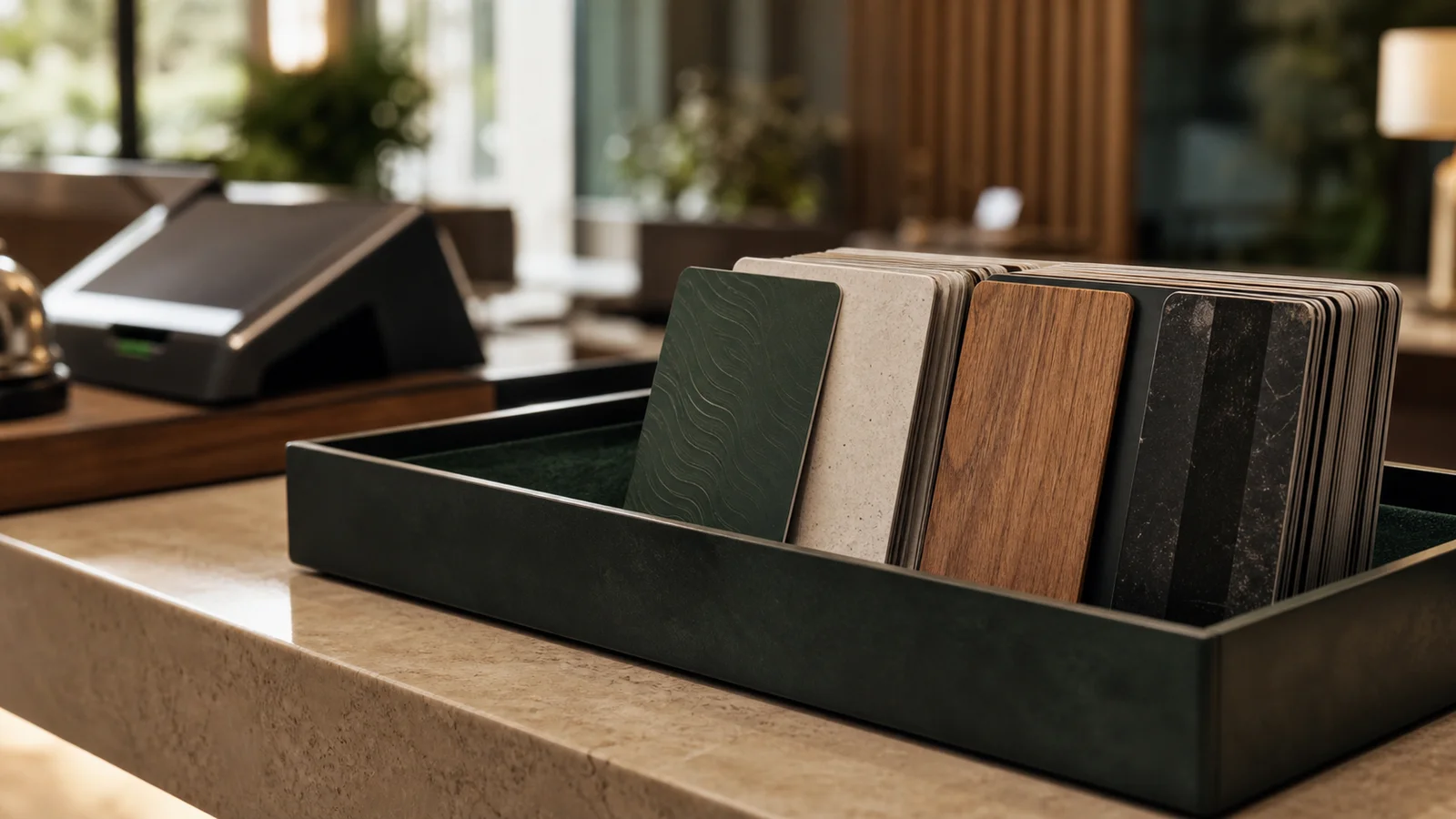
The economics explain the front-desk basket: a hotel replacing 20% of its cards monthly at guest-souvenir attrition rates spends real money — which is why many properties now pair durable cards with a visible return-and-reuse program. It is also the single biggest sustainability lever in the card lifecycle: the greenest card is the one that serves 200 guests instead of 2. For the material side of that story — wood-body, BioBoard-body and recycled-PVC options, with complete-construction end-of-life guidance — see our eco-friendly hotel key cards guide.
When Cards Should Be Retired
From our production experience, cards should leave rotation when:
- Magstripe stock fails the agreed checks — track batches and investigate repeated read/write failures rather than using an unsupported fixed re-encode count.
- Edges delaminate or corners crack — damaged lamination lets moisture reach the inlay and eventually kills RFID cards too.
- Print wear undermines the brand — a scuffed, faded card is often the most-handled branded object of the entire stay. Many properties refresh card designs on a fixed cycle for exactly this reason; reprints with custom printing are faster than first orders since artwork and plates are on file.
For Hotels: Making Cards Last Longer
- Consider RFID. Compare the selected chip and finished-card construction with the installed reader, encoder and operating requirements. All PrintPlast hotel key cards ship with chips tested and UID-verified before dispatch.
- Run a return program. A checkout basket and a one-line prompt at the desk measurably raise return rates — and guests increasingly read it as a sustainability signal.
- Store stock flat, cool, and dry. Card stock warps in hot storerooms before it ever meets a guest.
- Buy consistent stock. Mixed-batch cards age unevenly and fail unpredictably. Agree the materials, production parameters and acceptance criteria across reorders, and compare year-three and year-one stock through inspection and actual read/write tests.
Frequently Asked Questions
Do hotel key cards expire?
Access rights can expire at the checkout time configured by the property. If you extend your stay, ask the front desk to update the permissions according to its system’s procedure. Expiry does not mean the physical card has worn out.
Can I keep my hotel key card as a souvenir?
Policies vary. Ask the hotel before keeping a card; expiry alone does not prove that all access rights have ended or that no data remains. Returning a serviceable card lets the hotel inspect and reuse it. Distinctive cards (wooden ones especially) get kept so often that some properties budget for it deliberately as take-home branding.
How many times can a key card be reprogrammed?
There is no universal reprogramming count for every card. For magstripe, verify stripe condition and read/write performance. For RFID, consult the selected chip’s write-endurance specification and inspect the complete card; neither determines the other’s lifetime.
How long do wooden key cards last compared to plastic?
Service life depends on the selected wood or PVC construction, finish, handling and exposure conditions; compare finished samples against agreed tests. The complete RFID card also contains electronics and assembly materials, so disposal depends on its material declaration and locally available facilities rather than a universal decomposition time. Details in our eco-friendly hotel key cards comparison.