
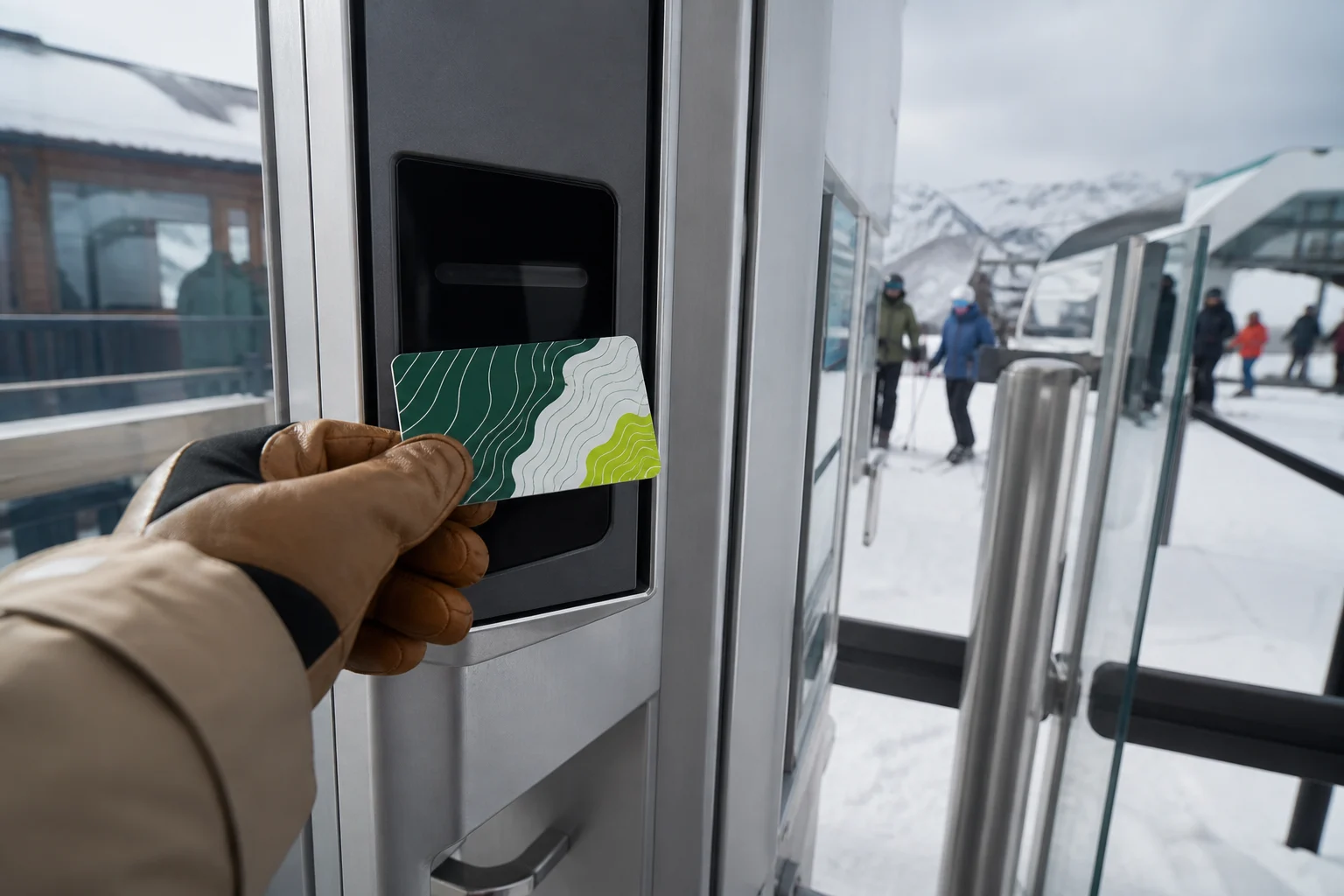
Ordering RFID ski pass cards is not simply a print purchase. The finished credential must communicate with the installed lift readers, survive its intended service life, carry the right guest information and fit the resort's issue-and-return workflow. A beautiful card with the wrong RFID specification is still the wrong card.
This guide gives lift operations, IT, procurement and guest-experience teams a shared brief. If you already know your requirements, explore PrintPlast's full range of RFID ski pass cards and resort wristbands or send the checklist at the end of this guide with your quotation request.
Start with the lift reader—not the card artwork
“RFID card” describes a broad family of contactless credentials. Two cards can look identical while using different frequencies, standards, memory structures or antenna designs. Before material and artwork decisions, document the lift-gate reader and the way the access platform expects the credential to be encoded.
The useful technical brief normally includes:
- Reader or system information: manufacturer documentation, frequency and supported air-interface standard.
- Credential data: whether the system reads a factory identifier, encoded sector, serial number or another data structure.
- Encoding responsibility: whether the factory, resort or ticketing integrator writes the required data.
- Physical constraints: card dimensions, thickness, slot or hole position and printer requirements.
- Every intended reader: lifts, parking, lockers, rooms and payment terminals may not accept the same technology.
Common HF credential families may use standards such as ISO/IEC 14443 or ISO/IEC 15693, but the standard alone does not prove compatibility. Frequency, data format, antenna performance and the finished card construction all matter. The safest procurement step is a reader-matched finished sample tested on the resort's actual equipment.
Day pass, multi-day pass or season pass?
The expected use period changes the right construction. A day credential may prioritize low unit weight, rapid issue and simple visual identification. A season pass must tolerate months of pockets, wallets, moisture, cold-to-warm transitions and repeated presentation at the gate.
| Program | Operational priority | Useful options |
|---|---|---|
| Day pass | Fast issue and clear date or zone recognition | Permanent print, barcode or QR, sequential number |
| Multi-day pass | Durability through the guest's complete stay | Variable guest data, sleeve, robust surface finish |
| Season pass | Long service life and secure identification | Photo, name, signature panel, premium card body |
| Reusable program | Return, erase and reissue workflow | Thermal-rewritable surface, return messaging, sorting |
Permanent print or thermal-rewritable surface?
Permanent printing is well suited to branded cards whose visual content does not change. Variable names, numbers, photos, QR codes and barcodes can be applied during production. It gives the design team the widest choice of colours and finishes.
A thermal-rewritable surface lets compatible on-site equipment display and later replace temporary information. It can support reusable pass programs, but only when the complete workflow is designed around it: the resort printer, expected rewrite cycles, return rate, cleaning process, visual density and card material must all be considered. Request a sample that has been produced in the proposed final construction and test it through the resort printer as well as the lift reader.
Choose the card body for the program
Recycled PVC
Recycled PVC offers familiar card handling, a broad range of print and finishing options, and constructions suited to permanent or thermal-rewritable programs. It is a practical choice when operational continuity and high-volume personalization are the main priorities.
Wood
Wood gives season, VIP and hospitality credentials a distinctive alpine character. Grain, laser engraving, colour print and foil can make the card part of the resort experience. Because wood is a natural material, approve the actual species, thickness, sealing and finished reader performance—not only a digital rendering.
Plant-fibre card bodies
Rigid plant-fibre formats such as BioBoard can reduce reliance on conventional plastic for selected day, multi-day or hotel programs. Confirm moisture resistance, print finish, reader range and the local end-of-life route before making an environmental claim.
No material is universally “most sustainable.” The stronger decision compares material origin, required durability, transport, return rate, reuse cycles and the realistic disposal route. PrintPlast can supply wood, recycled PVC, plant-fibre and wearable formats within one coordinated resort program.
Design for cold, moisture and real guest behaviour
The RFID inlay sits inside a physical object used in a demanding environment. Cards travel between freezing outdoor conditions, warm restaurants, wet gloves, jacket pockets and crowded lift queues. Specify the service conditions honestly and evaluate:
- edge sealing and resistance to routine moisture;
- surface durability against pockets, wallets and repeated handling;
- read performance in the guest's typical presentation position;
- legibility of dates, zones and instructions in low light;
- lanyard, clip, slot or sleeve requirements;
- performance after repeated cold-to-warm transitions.
“Waterproof,” “cold-proof” and fixed read-range promises should be treated carefully unless they are tied to a defined test method and final construction. A resort-specific sample trial is more useful than a generic material claim.
Plan personalization and data before production
RFID encoding and visible personalization are separate parts of the job. Decide which data must be inside the credential, which must be printed on it and which remains only in the resort's software. Typical visible elements include guest name, photograph, pass type, validity period, serial number, QR code, barcode and emergency or return instructions.
For variable production, agree the data-file format, field lengths, fonts, image quality, missing-data rules and approval process. Ask for a representative proof containing long names, accented characters and the densest barcode or QR example—not only an ideal sample row.
One card for the entire resort—or a coordinated credential family?
A lift pass can sometimes also open a hotel room, locker or payment account, but it should never be assumed. Each system has its own supported credential and security architecture. When all touchpoints share a compatible design, one card may simplify the guest journey. When they do not, a coordinated family—such as a lift card plus a resort wristband and hotel key—can be more reliable.
Use the companion guide, One RFID Credential for the Entire Ski Resort, to map lifts, rooms, lockers, rentals and payments before deciding on the physical format.
Sampling and acceptance testing
A sample should answer operational questions, not merely approve colour. Test it on every relevant reader and printer, using the same guest presentation and issue process expected during the season.
- Confirm the technical construction. Frequency, standard, data format, antenna, dimensions and material.
- Produce the finished sample. Use the intended card body, print layers, finishes, slot and personalization.
- Test each touchpoint. Include lift lanes, ticket desk, handheld readers, lockers, hotel doors and any payment terminals in scope.
- Record acceptance. Approve read reliability, on-site printing, visual quality and physical handling before the production run.
RFID ski pass quotation checklist
Send these details for an accurate quotation:
- card, wristband or coordinated credential type;
- reader/system information and supported frequency or standard;
- day, multi-day, season or reusable use period;
- quantity by design, pass type and delivery location;
- material, dimensions, thickness and slot or hole requirements;
- permanent or thermal-rewritable surface;
- RFID encoding and visible variable-data requirements;
- artwork, special finishes and packaging sequence;
- required sample date and production delivery date;
- all resort touchpoints where the credential must work.
Common buying mistakes to avoid
- Choosing a card by dimensions or frequency alone.
- Testing a generic blank inlay instead of the finished construction.
- Assuming the lift credential will automatically work on room or locker readers.
- Selecting a thermal surface without testing the resort printer and rewrite workflow.
- Approving artwork before checking variable-data edge cases.
- Making broad sustainability claims without considering lifespan, returns and end of life.
- Leaving too little time for samples, system testing, personalization and split deliveries.
Build a ski pass specification that works at the gate
PrintPlast manufactures custom RFID ski pass cards, resort wristbands, room keys and supporting credentials. Share your reader details and program requirements to start with a finished, reader-matched sample.