
Last updated: June 2026
Over the past decade, hotels have invested heavily in branded mobile apps: mobile check-in, room service ordering, spa booking, local guides. The strategy sounds right. The numbers tell a different story — fewer than one in five guests ever download a hotel app, and many of those who do delete it the day they check out. For a single property or a small group, the most expensive digital channel is often the one nobody uses.
Why guests don't download hotel apps
The problem is not your app. It is the format itself. Before a guest sees a single screen of your carefully designed experience, you are asking them to:
- Find the app in a crowded app store, often at the least convenient moment — standing at reception with luggage
- Download and install it, sometimes on hotel Wi-Fi they have not yet connected to
- Create an account, confirm an email address, and set yet another password
- Grant permissions and accept notifications they do not want
- Keep it installed for a stay that may last only one or two nights
Every one of those steps loses guests. A loyalty member staying forty nights a year with one brand may accept this friction. The leisure guest spending three nights at your property almost never will. For independent hotels and small luxury groups, that means the app reaches only a small minority of the people sleeping in your rooms tonight.
The economics of an app nobody opens
An app is not a one-off purchase. It is a permanent engineering commitment: two platforms to maintain, operating system updates to chase, app store reviews to manage, and a content backend to keep current. All of that overhead is carried by the small minority of guests who actually install it. When you divide the real cost of ownership by genuine guest usage, the app is routinely the worst-performing channel a hotel pays for — it just rarely gets measured that way.
The channel guests already carry: the key card
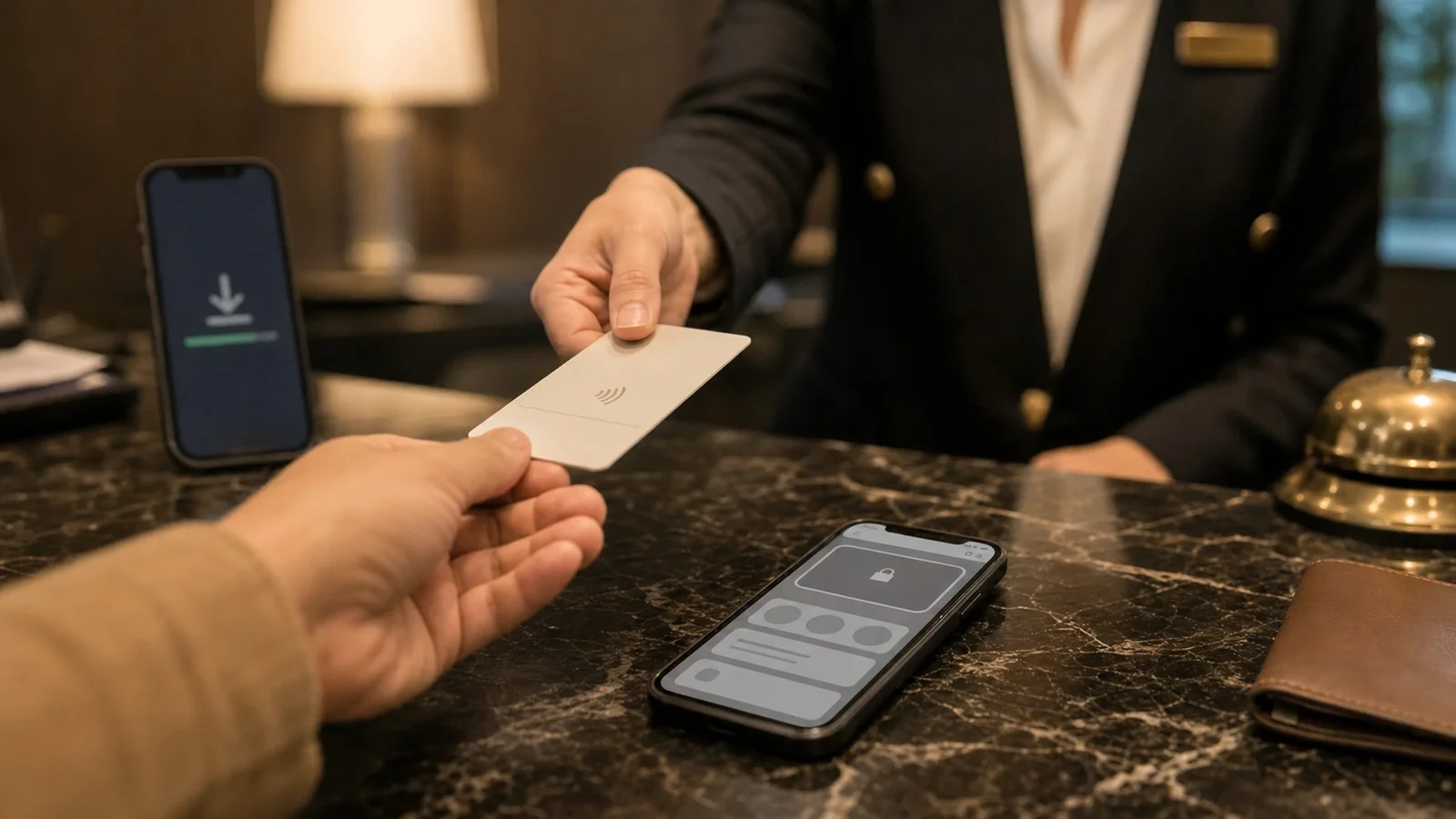
There is one object every single guest receives, carries all day, and keeps within reach for the entire stay: the room key. RFID hotel key cards already sit in every guest's pocket — the question is whether your card only opens a door, or also opens a conversation.
That is the thinking behind TAP by PrintPlast, our digital guest experience platform. TAP is a dual-chip NFC key card: one chip works with your existing lock system exactly as before, and a second NFC chip talks to the guest's phone. The guest taps the card on their iPhone or Android NFC phone, and an AI concierge web page opens instantly — no app, no download, no account, no password.
Hotel app vs. NFC key card, side by side
| Branded Hotel App | TAP NFC Key Card | |
|---|---|---|
| Guest effort to start | Find, download, install, register | Tap the room key on the phone |
| Share of guests reached | A small minority — fewer than one in five download | Every guest holding a key card |
| Works on | Phones with the app installed | iPhone and Android NFC phones |
| Languages | Whatever the app was built in | Auto-detects 30+ languages |
| Ongoing maintenance | Two platforms, store reviews, OS updates | A web page the hotel updates |
| Lock system impact | Separate mobile-key integration project | None — no lock hardware changes |
Why "no download" changes adoption
The difference between a tap and a download is not a detail — it is the whole game. A web experience that opens in one second from an object already in the guest's hand removes every adoption barrier at once. There is nothing to find, nothing to install, nothing to remember. And because TAP auto-detects more than 30 languages, the guest from São Paulo, Warsaw, or Istanbul lands on a page that already speaks to them — something very few hotel apps ever deliver.
For the hotel, the operational story is just as simple. The TAP card is still a normal RFID key card: it is encoded for your doors the same way, issued at the same front desk, and requires no changes to your existing lock system. The digital layer rides on top of the card you were going to hand out anyway.
Does this mean hotel apps are dead?
Not for everyone. Global loyalty programs with millions of repeat members can justify a native app; their most valuable guests use it. But for the independent hotel, the resort, the boutique group — properties whose guests may visit once a year or once in a lifetime — building app-grade engagement on top of a no-download channel is simply a better fit for how guests actually behave.
Frequently asked questions
Do guests need to install anything at all?
No. The guest taps the TAP card on their phone and a web page opens in the browser. There is no app, no account, and no sign-up of any kind.
Will the card still open the room door?
Yes. TAP is a dual-chip card: the access chip works with your existing lock system unchanged, while the second NFC chip handles the phone interaction. Front desk encoding workflows stay exactly as they are.
Which phones does it work with?
TAP works with iPhone and Android NFC phones. The card continues to function as a standard room key for every guest regardless of their phone.
Who is behind TAP?
TAP is built by PrintPlast, a hotel key card manufacturer since 1989 — 37 years of card production — serving more than 250 luxury properties worldwide.
Curious what your key card could do beyond opening doors? Explore TAP, the app-free digital guest experience, or talk to our team about a pilot for your property.