
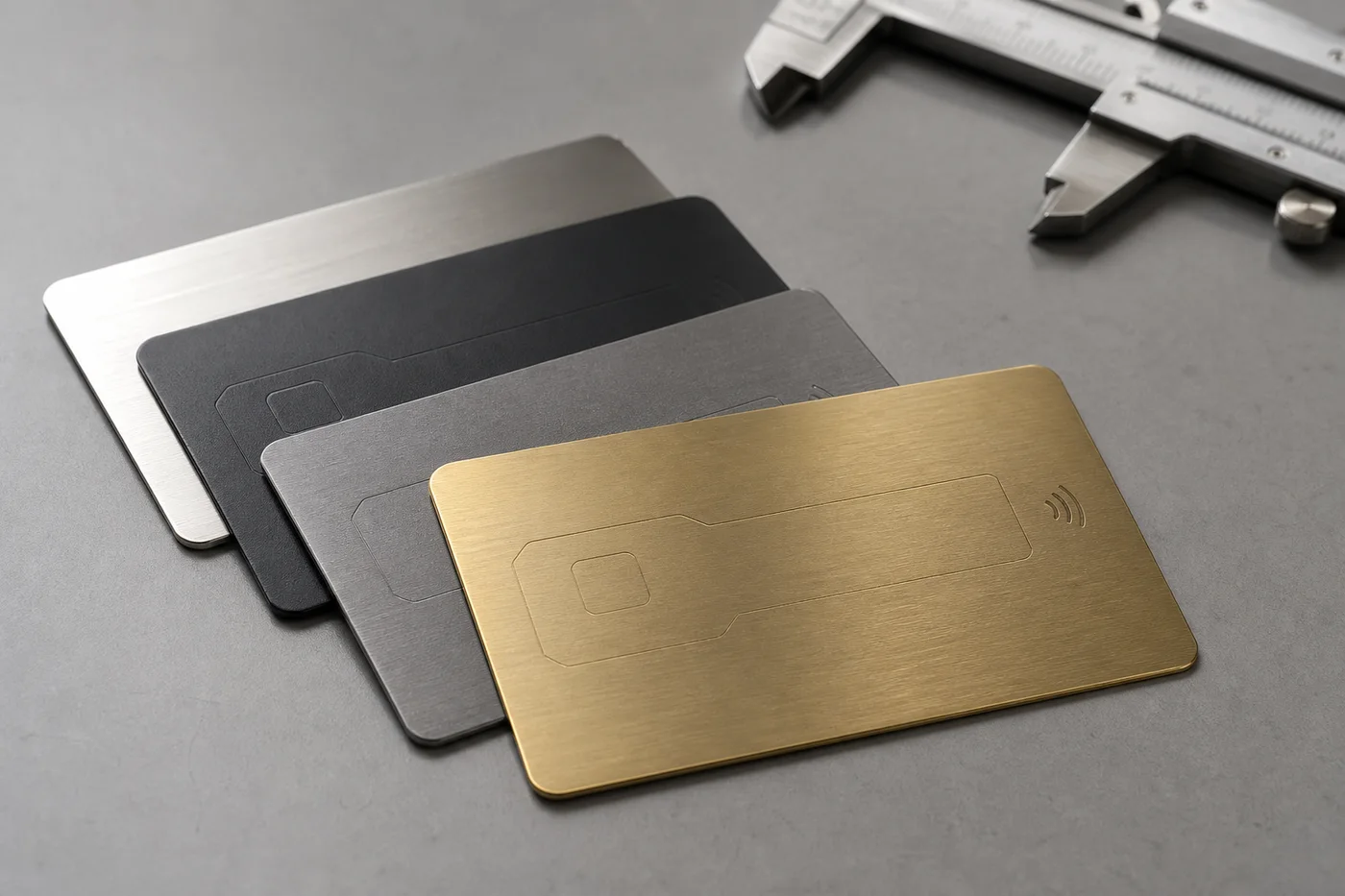
A metal RFID card taps for one reason: the metal is not the part the reader talks to. Behind the steel or brass face sits a ferrite layer, and behind that the antenna coil and chip. Ferrite is a ceramic iron-oxide compound with high magnetic permeability and high electrical resistance, so it gives the reader's field a controlled path instead of letting the conductive face swallow it. Remove that layer and the card is a coaster. Eddy currents form in the metal, generate an opposing field, detune the antenna, and the read range goes to zero.
Why bare metal kills the read
An RFID reader works by magnetic coupling. It puts out an alternating field, the card's coil antenna picks up energy from it, and the chip answers. Put a sheet of conductive metal in front of that coil and the field induces circulating currents in the metal itself. Those eddy currents produce their own opposing field, canceling most of what reaches the antenna, and they shift the antenna's resonant frequency away from where the reader is listening. Both effects push in the same direction: no read.
This is the same physics that makes ordinary NFC stickers stop working when you put them on a laptop lid or a machine housing. The industry's answer there is the anti-metal tag, which is just a standard inlay with a thin ferrite sheet bonded behind it. A metal card uses the same principle, but engineered into the card body rather than stuck on afterward. Payment-style metal cards add a second trick: a slot or aperture cut through the metal that breaks the eddy-current loop so the field can pass.
What is inside a working metal card
The stack matters more than the material. A metal card is a laminate, and every layer has a job.
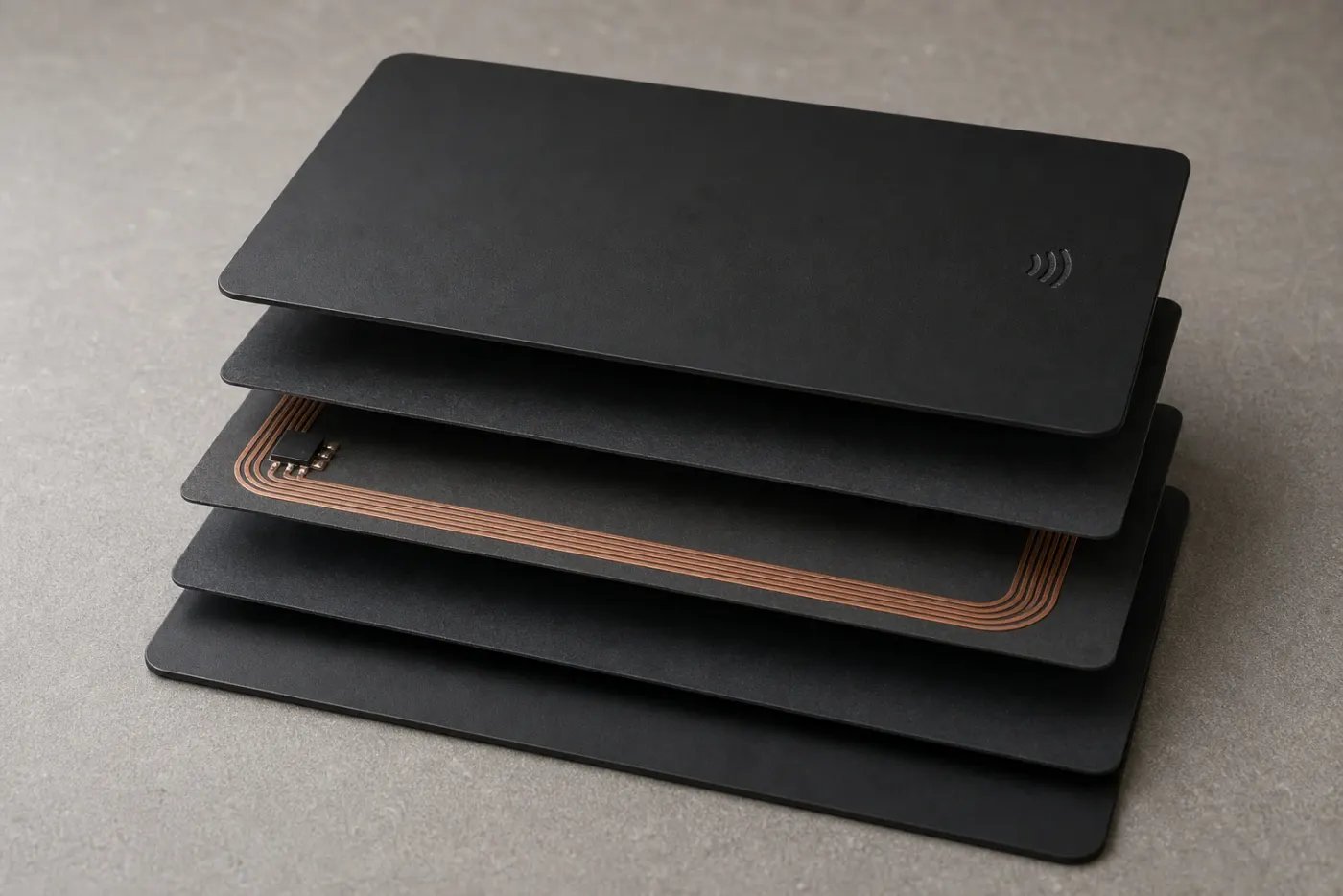
The antenna coil and chip sit between the faces, not behind bare metal. The shielding layer between face and coil is what makes the tap possible.
| Layer | Job | Typical detail |
|---|---|---|
| Front face | Appearance and marking surface | 304-family stainless, brass, copper, or PVD-coated steel a few microns deep |
| Ferrite / shielding layer | Redirects the magnetic field away from the conductive face | A fraction of a millimeter thick, die-cut to the card outline |
| Antenna and chip | The RFID function itself | Coil tuned to the final stack, not to a generic card |
| Core or spacer | Holds flatness and sets finished thickness | Determines where in the 0.3–0.8 mm range the card lands |
| Back face | Print, QR panel, serial numbers, legal text | Metal or a printable layer, depending on the build |
Because the antenna is tuned to the finished stack, thickness is not a free choice at the end of the process. Change the core and you change the tuning. That is why a metal card is quoted as a construction rather than a material, and why there is a page-by-page breakdown of the RF layer inside a metal card worth reading before you write a spec.
Frequency and chip choice
Metal does not remove any of the usual options, but it does change how much engineering each one needs.
| Frequency | Standard | Typical use | What metal changes |
|---|---|---|---|
| 125 kHz (LF) | Proprietary air interfaces | Legacy access control, rewritable credentials | Range is short to begin with, so the shielded build has less margin to lose |
| 13.56 MHz (HF / NFC) | ISO/IEC 14443A, ISO/IEC 15693 | Phone taps, access credentials, membership, encrypted AES-128 builds | The most common route for metal cards, and the one with the most proven constructions |
| 860–960 MHz (UHF) | ISO/IEC 18000-63 (EPC Gen2) | Asset tracking, longer-range identification | Antenna geometry and mounting dominate performance; placement testing is mandatory |
Whatever the frequency, one step does not change: an encoded sample is read on the exact phone, reader or lock the card will live with, before anyone runs a batch. A metal card that reads perfectly on a desktop USB reader can still fail on a wall reader with a different antenna and a metal backplate.
What metal changes in daily use
- Read distance is shorter. A shielded build gives back most of the range, not all of it. For a tap-on-contact reader nobody notices; for a reader people wave at from 4 cm away, test first.
- The card bends instead of snapping. PVC cracks and is obviously dead. Metal takes a permanent bend and keeps looking usable, which is worse for a returns cycle.
- You cannot run it through a desktop card printer. No thermal print, no embossing, no on-site personalization the way a hotel prints a room number on a PVC card. Marking happens at the factory.
- Weight is the selling point and the surprise. The difference against a 0.76 mm PVC card is obvious in hand, and it varies with construction, so judge it on a physical sample rather than a number in a table.
- Scratches read as wear, not damage. Brushed and matte faces hide handling; mirror faces show every fingerprint under lobby lighting.
Where metal belongs, and where it does not
We build hotel key card programs in wood, plant-based board and recycled PVC, so the question we get is usually the honest version: should the whole property switch to metal? Almost never. Room keys are a fleet item that gets handled thousands of times, walks out of the building in guests' pockets, and often needs a room number printed at the desk. Metal is wrong on all three counts, and the cost per card is not close.
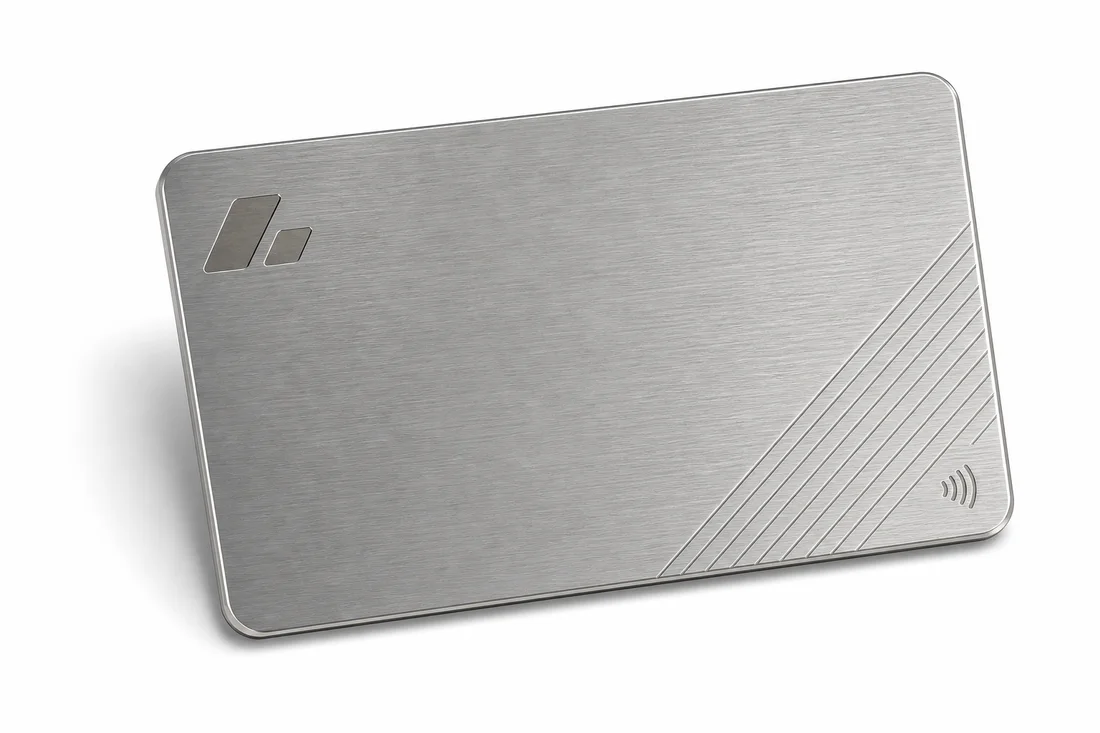
Brushed stainless is the reference build for metal RFID: a steel face whose conductivity is exactly why the construction behind it matters.
Metal earns its place where the card is a small population and a deliberate object. Residence and villa owners rather than nightly guests. Club, spa and dining memberships that stay in a wallet for years. Invitation and gift cards where the weight is part of the reveal. The general manager's own NFC business card. In those programs the card is a brand asset with a long life, and the premium disappears into a marketing budget rather than an operating one.
For everything issued at scale, the material decision is between wood, bio-based board and recycled PVC, which we compare in wooden vs BioBoard vs recycled PVC hotel key cards. If you are still choosing the technology rather than the material, what an RFID card is and our hotel key card guide cover the frequency and lock questions first.
Marking and finish decisions
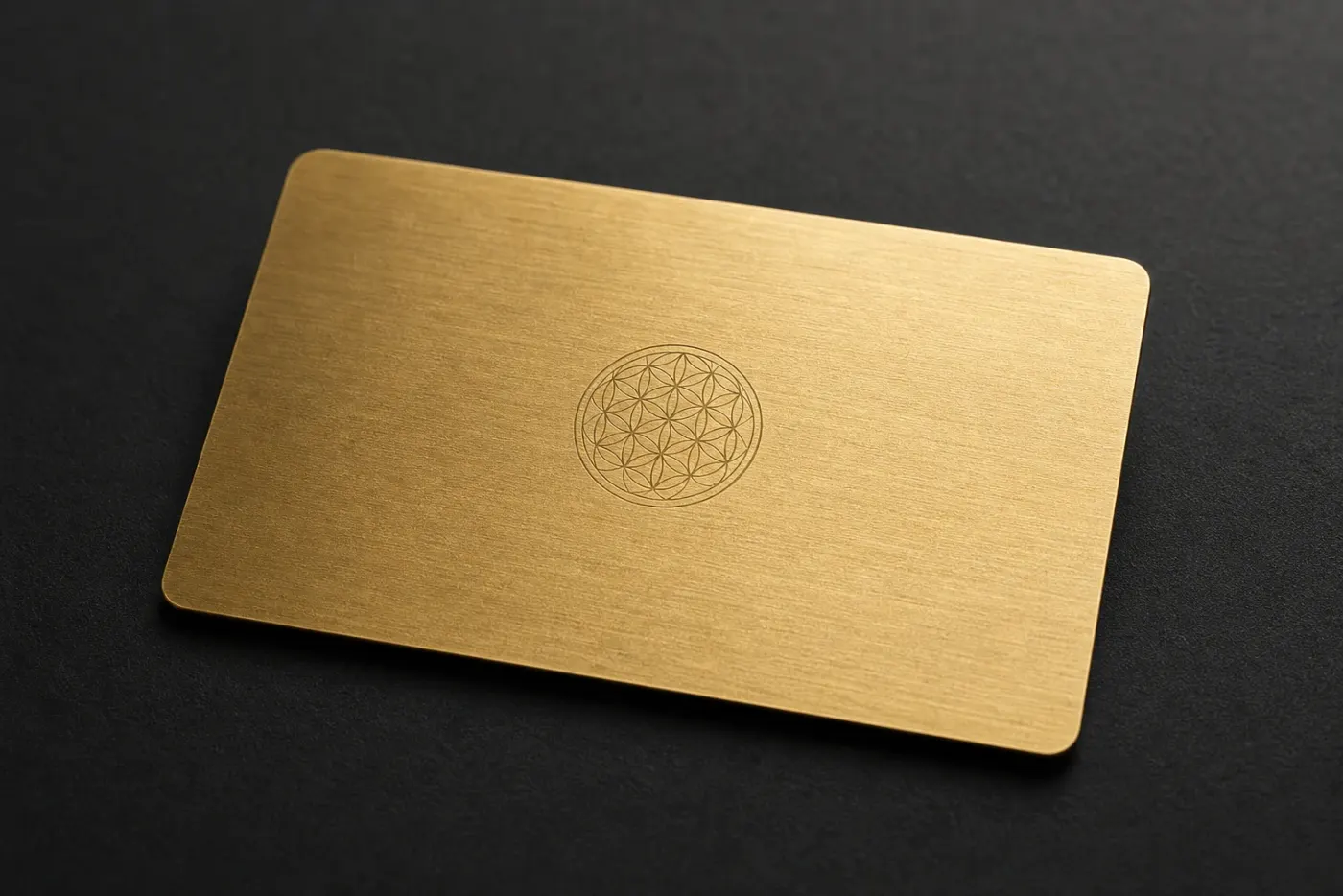
Laser engraving on brass holds fine line work that would fill in on a printed plastic card.
Metal marking behaves nothing like card printing, and the finish you pick decides what marking looks good on it:
- Coated black faces have the best contrast. The laser strips the PVD or coating back to bright steel, so the mark is a color change rather than an etch. Crisp at small sizes.
- Brass takes depth. It is a solid copper-zinc alloy rather than coated steel, softer under the tool, which is why deep engraving and enamel-style fills work on brass and not on thin plating.
- Copper is a living surface. Untreated it darkens toward patina. Decide at sample stage whether to clear-coat and hold the tone or let it age.
- Dark faces need a light panel for data. Grey-on-grey QR codes and serials fail scan tests. A printed panel behind them fixes it.
- Full color means UV print, usually over white ink. Metal has no white in it, so any light artwork needs a base layer laid down first.
What to check before you order
- An encoded sample read on your actual reader or lock, not a generic bench reader
- A dieline with any hole, slot or cut-through marked, reviewed against the antenna path before tooling
- Finished thickness confirmed against the reader slot or dispenser it has to fit
- Who encodes: factory-encoded and serialised, or delivered blank for your own system
- Edge and corner finish, which on metal is a visible design decision rather than a trim detail
Frequently asked questions
Do metal cards block RFID?
Bare metal in front of an antenna does. A finished metal RFID card does not, because the antenna sits behind a ferrite or shielding layer that gives the field a controlled path. The proof is always the same: an encoded sample tested on the target reader before production.
Will a metal card work in our hotel lock?
Usually yes on 13.56 MHz locks, but never assume it. Read range is shorter than on a plastic card, and lock readers vary in antenna design and mounting. Test one encoded card on the exact lock model, and on the desk encoder, before ordering a batch. Related reading: why hotel key cards stop working.
Can you print full color on a metal card?
Yes, with UV printing, normally over a white base layer so colors are not dragged toward the metal tone underneath. Laser marking and print are often combined on one card: engraved logo, printed data panel.
How thick is a metal RFID card?
Between 0.3 mm and 0.8 mm depending on construction, in the standard CR80 85.6 × 54 mm format. A standard PVC card is 0.76 mm, so a metal build can be thinner or slightly thicker than what your reader already accepts. That is a spec to confirm, not to assume.
If a metal build is genuinely what a project needs, metal RFID cards are documented there finish by finish, with the artwork and engraving specs. If the card in question is a room key for a whole property, ask us for a sample pack of wood, BioBoard and recycled PVC instead and put the three in your front desk team's hands.